Scaling a Monument: A New Digital Record for the Column of Marcus Aurelius
For the first time in a generation, one of Rome’s most iconic imperial monuments has been seen up close, thanks to a landmark conservation and digital documentation project of the Column of Marcus Aurelius.

With scaffolding enclosing the nearly thirty-metre shaft of the Column for the first time since the 1980s, the Soprintendenza Speciale Archeologia Belle Arti e Paesaggio di Roma carried out the restoration works on the monument, under the responsibility of Dr Marta Baumgartner, Sole Project Manager, and with the works directed by architect Andrea Valerio Canale.
This circumstance offered the opportunity to develop a digital documentation system in a 3D GIS environment, curated by Consorzio Futuro in Ricerca of the Università degli Studi di Ferrara and coordinated by architect Marco Zuppiroli. The cognitive and metric basis of the work was provided by the ultra-high-resolution photogrammetric survey of the entire sculpted surface of the Column, covering approximately 330 square metres, produced by architect Nicholas Christodoulidis. The survey made it possible to build a complete and queryable digital support system, aimed at reading, recording and managing the monument’s conservation information.The project was funded through ARL’s Expandere Conscientiae Lumen (ECL) Grant.
Inside a Spiral Frieze
Erected in the late 2nd century CE in Rome’s Campus Martius, the Column of Marcus Aurelius is among the Roman world’s most ambitious acts of visual storytelling. Its spiraling frieze, which wrapps the shaft in a continuous ascending band of carved relief, records the emperor’s campaigns along the Danube in vivid, and at times, brutal detail: soldiers crossing rivers, barbarian captives, divine interventions, the machinery of Roman war. More than two thousand figures inhabit its surface.

But it’s a hard read to the naked it making most of the storytelling effectively invisible, That is the central paradox of the Column. From street level, the upper registers dissolve into abstraction, and details are lost. This project changes that.
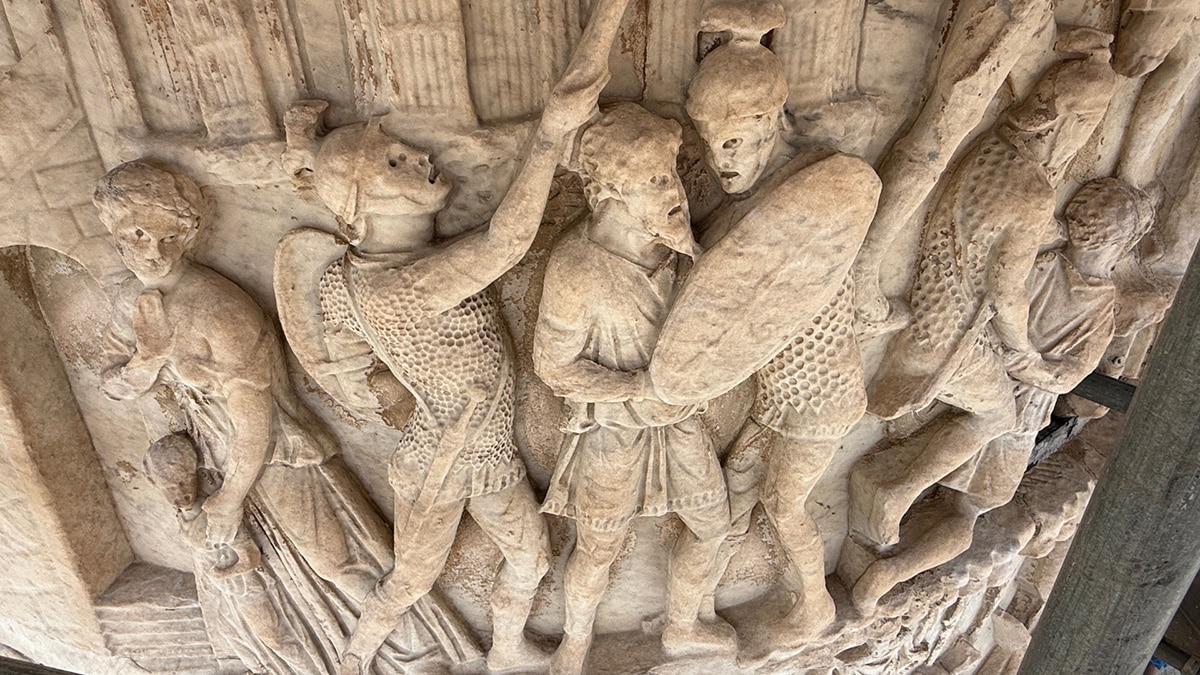
“From close up, it becomes possible to distinguish the coexistence of different materials and techniques, as well as restoration interventions carried out over time,” Zuppiroli explains. Stone inserts from Domenico Fontana’s 1589 restoration (inserted to fill degraded or missing portions of the relief) became legible alongside earlier fills, metal clamps, oxidized fasteners, and the nuanced layering of deposits that from street level read simply as darkening. In the Column’s most exposed northwestern sector, wind erosion and water runoff have left measurable losses in the sculptural modeling.
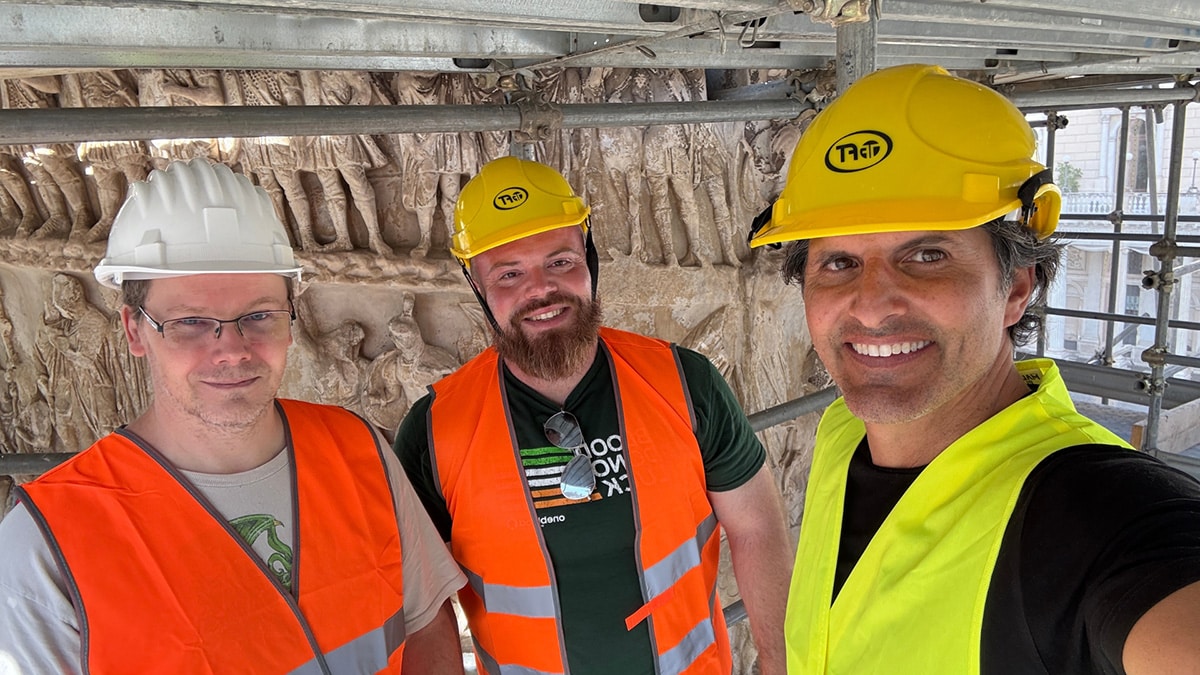
ARL Director Darius Arya, who went up on the scaffolding himself, describes the experience in terms that go beyond the technical. “Everyone else is down below — looking up with the naked eye, with cameras, with binoculars — but you’re up there at inches away from the relief. You see details that are simply invisible from street level. And it’s not just a visual experience; it’s three-dimensional. You’re looking around the figures in high relief, understanding the depth and the carving in a way you never could from the ground.”

Documentation at an Unprecedented Scale
The photogrammetric survey, produced by architect Nicholas Christodoulidis, recorded the surface of the Column with a Ground Sample Distance of 0.1 mm per pixel, a level of detail higher than the 0.5 mm standard normally adopted for high-precision architectural surveys. At this resolution, chromatic variations, microfractures, stone inserts and surface discontinuities become readable as precise, measurable and mappable data, rather than merely qualitative visual observations.
That level of detail is not merely descriptive. It transforms how conservation decisions are made. The photogrammetric mesh captures the full geometry of the frieze’s spiral surface – tracking which north-facing zones accumulate biological growth, which protruding relief elements are most vulnerable to fracture, which recessed passages trap particulate matter. Degradation, in other words, can now be read in direct relation to the Column’s actual three-dimensional form rather than as a phenomenon distributed generically across its surface.
Zuppiroli’s team has built this data into a three-dimensional information system that integrates material records, conservation treatments, and predictive vulnerability modeling into a single consultable platform which will be updatable over time and designed to support monitoring well into the future.

Conservation at a Critical Moment
Though the Column has stood for nearly two millennia, it has received surprisingly little systematic attention. The last major conservation intervention predates the internet. Much of the architectural evidence of previous restorations (i.e. fills, metal pins, mortars and resins applied across centuries) had never been fully inventoried. This project changes that.
“The surface of the Column appears as the result of the interaction between ancient material, previous restoration and consolidation interventions, and past and still active degradation processes,” Zuppiroli observes. The project provides what he describes as “a knowledge base of great value” – one indispensable to the construction of the information system and to any serious planning of future conservation.
For Arya, the experience was unique.. “I don’t know when scaffolding will go up again. It’s been fifty years since the last time. It may be another fifty. So this was a once-in-a-generation opportunity.”
A Monument Made Accessible
The project’s ambitions extend well beyond the conservation record. Among the planned public outcomes is a virtual “climb” of the Column, allowing users to follow the frieze in its ascending sequence. Free VR experiences for schools and universities worldwide are also in development, along with the possibility of a digital chromatic reconstruction of the Column’s original polychromy, a reminder that the ancient world did not, in fact, look like white marble.
That last element will be handled with care. Any color reconstruction, Zuppiroli notes, will be presented as a clearly marked interpretive layer, distinct from the documented state of the monument because, as he puts it, “the digital image has a strong persuasive capacity, and what is presented visually risks becoming fixed in public perception as certain and definitive information.”
“This is one of the great narrative monuments of the ancient world,” Arya says, “and for the first time we’ll be able to experience it at a resolution and from perspectives that even the people who commissioned it never had.”
The Column of Marcus Aurelius Digital Scan is an ECL Grant project, funded by Ancient Rome Live. Learn more here.