At a high-altitude site in the Apennines, the 2026 excavation season at Cardito Vecchio uncovers a monumental medieval church — on ground that once sat squarely on the Gustav Line.

High in the Apennines above Vallerotondo, the Cardito Vecchio excavation, a project Ancient Rome Live is proud to partner on, has wrapped its 2026 season with a striking discovery: the remains of a large medieval church, complete with painted frescoes, that had lain buried in these mountains for nearly a thousand years.
The find caps a four-week dig season at the site, carried out under a ministerial concession granted to the Municipality of Vallerotondo. The project brought together a multidisciplinary team under Scientific Director Professor Michele Raddi and Deputy Director Dr. Andrea Ceccarelli, with ARL Director Darius Arya part of the core research staff alongside researchers Dr. Emilio Angelone and Dr. Alice Lorenzoni. A co-financing arrangement has allowed the excavation to continue across multiple seasons.

A Building Too Big to Be a Chapel
This season’s digging uncovered the outline of a surprisingly large religious building (approximately 20 by 10 meters) buried in Test Trench 3. The team identified the building’s apse, recovered fragments of painted plaster bearing red, brown, and black decorative motifs in Sector 1, and found pieces of imported marble suggesting the church floor included material brought in from elsewhere. Material recovered at the site, especially evidence that people were using the building in the 12th and 13th centuries, confirms it played a real role in medieval life in this part of the Apennines. Its size, along with the layers of soil and material around it, suggests this wasn’t a simple village chapel, but something more important: likely a baptismal church, or pieve, or possibly a monastic outpost connected to the powerful Abbey of Montecassino.

“The main thing that makes us think of this church as a pieve is the scale of it,” explains Professor Raddi. “It is much larger than a single chapel, and we realized it was something quite monumental when we uncovered the apse.” The frescoes recovered in Sector 1 point to a building that was well decorated, he adds, and fragments of imported marble found at the site suggest the church’s pavement included material brought in from elsewhere — a further sign of the building’s status.
The dig itself was no easy undertaking. “It’s very difficult to excavate at this elevation,” Raddi says. “Even arriving at the site, along the old Samnite road, is quite difficult. That’s why I always call this extreme archaeology.”
Why the Site Matters to ARL
The medieval church is the headline discovery, but it’s not the only reason Ancient Rome Live got involved. Cardito Vecchio also has a pre-Roman story to tell: earlier excavation seasons turned up traces connecting the site to the Samnites, the ancient peoples who controlled this stretch of the central Apennines long before Rome did. That deeper history is part of what drew ARL to the project in the first place.
“It truly is a great discovery and helps us understand this portion of Samnite territories,” said ARL Director Darius Arya.
A Mountain With Two Histories
Cardito Vecchio’s story doesn’t stop in the Middle Ages. The same ridge that made this spot valuable to a 12th-century church builder made it valuable to a Samnite chieftain, a Roman commander, and, centuries later, a German army – all for exactly the same reason.
Vallerotondo lies in the mountains directly above Cassino, where the Gustav Line (the German defensive position that ran for roughly one hundred miles from the Tyrrhenian coast through Monte Cassino and across the central Apennines) held off the Allied advance toward Rome through the winter of 1943 into 1944. The Benedictine Abbey of Montecassino itself, founded in 529 CE, was reduced to rubble by Allied bombing in February 1944, the very bombing run, comments Gustav Line Association chair Damiano Parravano, that may have left its mark on Cardito Vecchio on the way home.
“The connection between Cardito Vecchio and the Gustav Line is that this same elevated hill overlooks the valley and overlooks important mountain passes,” explains Parravano.”It’s an important place to control. It was the case with the Samnites. It was the case with the Romans, and it was the case for the Norman church. And ultimately, it was the case for the Germans, who were interested in cutting the Allies off from getting into the northern part of Italy. This is a critical juncture that had to be controlled.”

That continuity isn’t just historical reasoning, it’s physical. “On the site, we find a series of well-preserved foxholes dug in by the Germans,” Parravano says. The church itself was bombarded during the war. “At this point, we think it was, in fact, a bomb dropped by bombers returning from a run on Monte Cassino — they would discard unused bombs on the way home to lighten the load for the flight back. That’s where we think this bomb came from, because by the time the bombing was taking place at Monte Cassino, the Germans had already been displaced and moved from this position.”
It’s this layered history that makes the group’s involvement in the project so natural. The group’s expertise in the region’s 20th-century military landscape –its fortifications, terrain, and wartime accounts — helps researchers understand how the more recent past intersected with, and in places disturbed, the older remains underneath it.
An International Team
For Arya, this season’s value was as much about the people involved as the discovery itself. “It’s just a great pleasure to see this international collaboration,” he said. “We had three students from the United States, and we are happy to continue for another season. It’s been an incredible discovery of the 12th/13th-century church with the frescoes. It’s fantastic, and really great exposure and collaboration with the local community.”

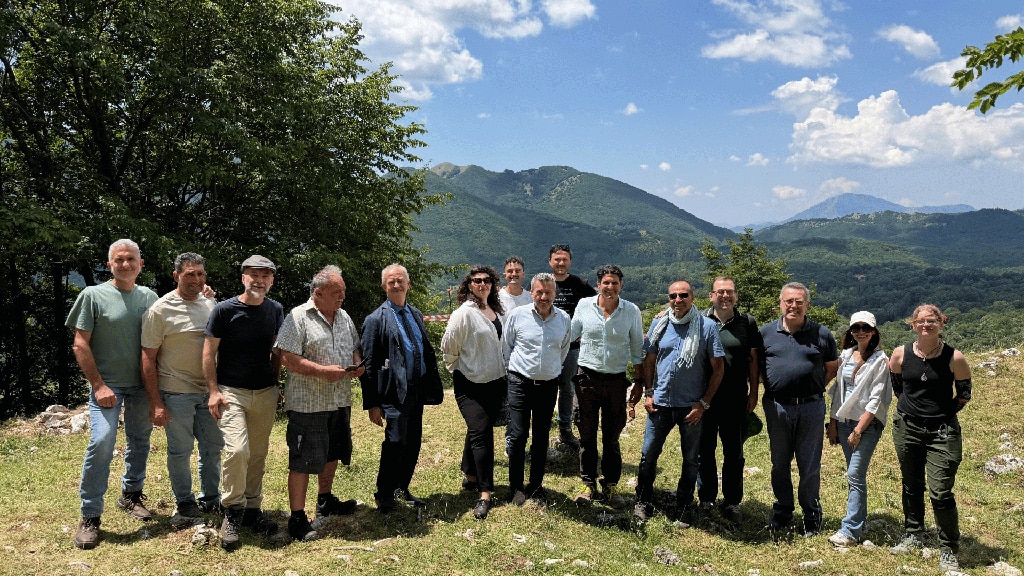
The dig concluded on June 24, 2026, with a press conference and site visit at Cardito Vecchio. In attendance were Superintendent Dr. Alessandro Betori and Superintendency archaeological officials Dr. Massimo Lauria, Dr. Carlo Molle, and Dr. Caterina Paola Venditti, along with Vallerotondo Mayor Ing. Giovanni Di Meo and Professor Raddi.
“The success of these investigations is the result of exemplary institutional synergy,” said Mayor Di Meo. “We are proud to contribute to the protection of a heritage that speaks to the deep roots of our Apennines.”
With the 2026 season wrapped and funding in place to keep the work going, the team is already looking ahead to next week, with continued work on the church and new excavation of a probable Samnite temple beneath a Norman tower.