
Roman Emperor · 211 CE · Severan dynasty
Official nameImperator Caesar Publius Septimius Geta Augustus
BornMarch 7, 189 CE, Rome or Mediolanum (modern Milan)
(Historia Augusta, Life of Geta, 3; Life of Septimius Severus, 4)
ReignCaesar from 198 CE; co-emperor from February to December 211 CE
(Historia Augusta, Life of Geta, 5; Herodian 3.15.7)
ParentsSeptimius Severus and Julia Domna
Predecessor / Co-emperorSeptimius Severus / Caracalla (his brother)
DeathDecember 211 CE, Rome, aged 22. Murdered by soldiers loyal to Caracalla, in his mother’s arms.
(Cassius Dio, Roman History, 78.2; Herodian 4.4.3)

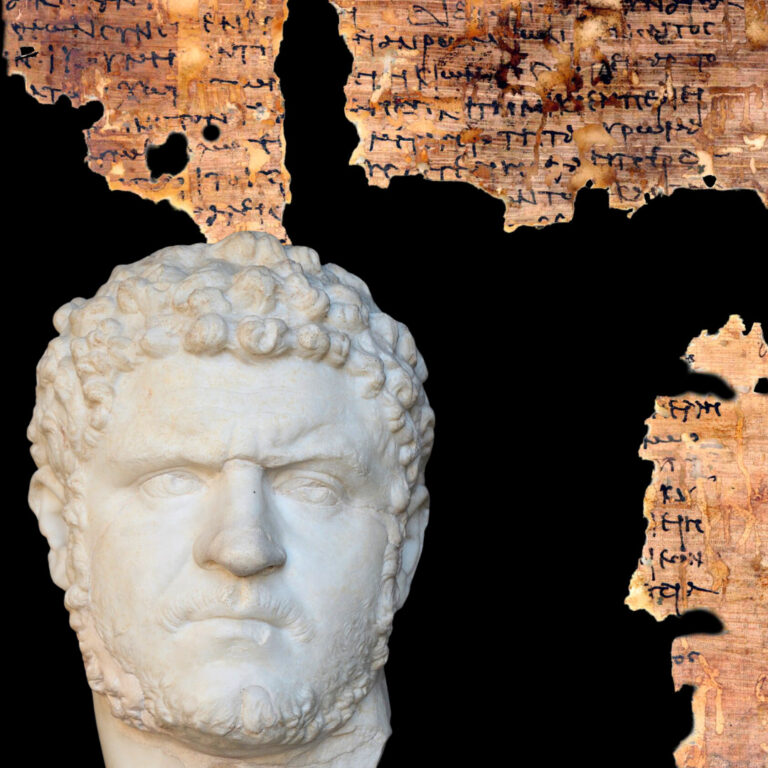
Bust of Geta, Palazzo Massimo alle Terme, Rome
Publius Septimius Geta Augustus was born on March 7, 189 CE, in Rome or Mediolanum (modern Milan). As the younger son of Emperor Septimius Severus and Empress Julia Domna, Geta was born into one of Rome’s most powerful imperial families. His short life would become one of the most tragic episodes in Roman imperial history, remembered for the bitter rivalry with his brother Caracalla that ultimately ended in murder.
Geta entered public life at an exceptionally young age. In 198 CE, when he was just eight years old, Septimius Severus elevated him to the rank of Caesar, formally naming him heir alongside his older brother, Caracalla. From that point onward, the two princes were expected to rule together as members of the Severan dynasty.
Despite their shared status, the brothers developed an intense mutual hatred that only worsened as they grew older. Ancient sources describe a relationship marked by constant jealousy, competition, and distrust, creating deep divisions within the imperial household.
The rivalry reached its breaking point after the death of Septimius Severus at Eboracum (modern York) in February 211 CE. Caracalla and Geta succeeded their father as joint emperors, but their hostility made effective government almost impossible. Returning to Rome, they reportedly divided the imperial palace into separate living quarters, each surrounded by loyal guards and refusing to enter the other’s territory. They conducted official business independently and would only meet in the presence of their mother, Julia Domna, who made repeated but unsuccessful attempts to reconcile them.
In December 211 CE, Caracalla decided to remove his brother permanently. Under the pretext of a family reconciliation, Geta was invited to meet in Julia Domna’s apartments. There, soldiers loyal to Caracalla attacked and stabbed the young emperor to death. According to the ancient historian Cassius Dio, Geta died in his mother’s arms at just 22 years of age.
The murder was followed by one of the most extensive examples of damnatio memoriae in Roman history. Caracalla ordered Geta’s name erased from inscriptions, his portraits and statues destroyed, and his image removed from coins and public monuments throughout the empire. Even paintings depicting the imperial family were altered to erase his likeness. Julia Domna was reportedly forbidden from openly mourning her younger son.
Caracalla also launched a widespread purge of those suspected of supporting Geta. Ancient authors claim that thousands of officials, soldiers, and associates were executed or exiled, although the exact number remains uncertain. The campaign eliminated potential rivals and secured Caracalla’s position as sole emperor, while reinforcing his reputation for cruelty.
Although Geta ruled for less than a year, his violent death has ensured his place in Roman history. His assassination remains one of the clearest examples of dynastic violence within the Roman Empire and illustrates the deadly consequences of imperial succession disputes. Ironically, despite Caracalla’s determined efforts to erase his brother from history, Geta is remembered today largely because of the brutality of that attempted erasure.
Bibliography
- Birley, Anthony R. Septimius Severus: The African Emperor. Rev. ed. Routledge, 1999.
- Levick, Barbara. Julia Domna: Syrian Empress. Routledge, 2007.
- Potter, David S. The Roman Empire at Bay, AD 180–395. 2nd ed. Routledge, 2014.
- Varner, Eric R. Mutilation and Transformation: Damnatio Memoriae and Roman Imperial Portraiture. Brill, 2004.
189 CE
Born on March 7, the younger son of Septimius Severus and Julia Domna.
(Historia Augusta, Life of Geta, 3)
198 CE
Named Caesar at the age of eight, heir alongside his brother Caracalla.
(Historia Augusta, Life of Geta, 5)
211 CE
Becomes joint emperor with Caracalla after their father dies at Eboracum in February.
(Herodian 3.15.7)
211 CE
The brothers divide the imperial palace and meet only in their mother’s presence.
(Herodian 4.1.5)
211 CE
Murdered in December on Caracalla’s orders, in his mother’s arms.
(Cassius Dio, Roman History, 78.2)
211 CE
Caracalla condemns his memory and purges thousands of his supporters.
(Cassius Dio, Roman History, 78.4, 78.12)

This content is brought to you by The American Institute for Roman Culture, a 501(C)3 US Non-Profit Organization.
Please support our mission to aid learning and understanding of ancient Rome through free-to-access content by donating today.
Join our free newsletter to receive more ancient Rome content, lecture and Masterclass invites, travel course news and more:
Cite this page as: Ancient Rome Live, The American Institute for Roman Culture, “Geta“. Last modified
November 16, 2026. https://ancientromelive.org/geta/
Created by The American Institute of Roman Culture, published on
May 29, 2023 under the following license: Creative Commons: Attribution-NonCommercial-ShareAlike. This license lets others remix, tweak, and build upon this content non-commercially, as long as they credit the author and license their new creations under the identical terms. Please note that content linked from this page may have different licensing terms.