
Roman Augusta · 222–235 CE · Severan dynasty
Official nameJulia Avita Mamaea Augusta
BornBetween about 184 and 192 CE, Emesa, Syria (modern Homs)
(Herodian 5.3.2–3; Cassius Dio, Roman History, 79.30)
Augusta222–235 CE, as mother of the emperor Severus Alexander
(Cassius Dio, Roman History, 79.30; Historia Augusta, Life of Severus Alexander, 60)
ParentsGaius Julius Avitus Alexianus and Julia Maesa; niece of Julia Domna
MarriageMarcus Julius Gessius Marcianus (died 218)
(Cassius Dio, Roman History, 79.30, 79.33–34)
ChildrenSeverus Alexander
(Cassius Dio, Roman History, 79.30)
DeathMarch 235 CE, near Mogontiacum (Mainz), killed with her son by mutinous soldiers
(Historia Augusta, Life of Severus Alexander, 60)

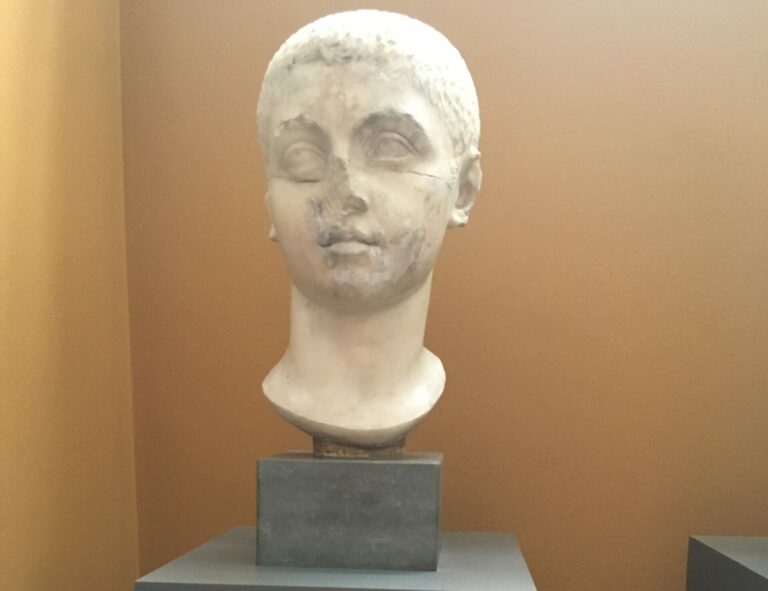
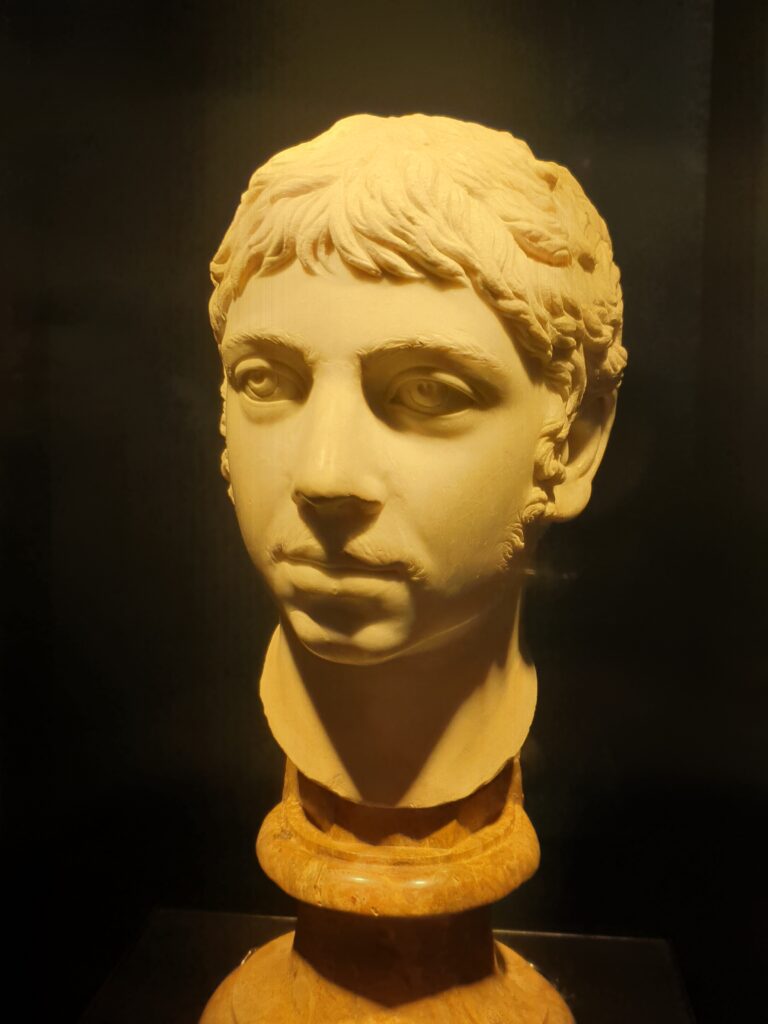
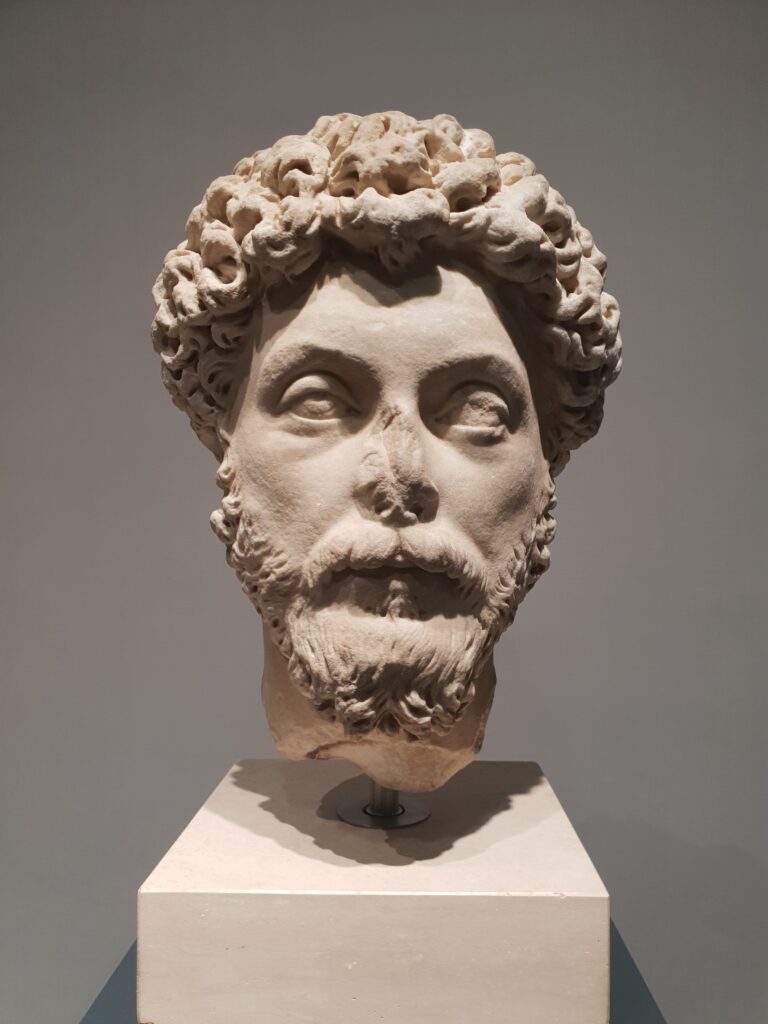
Portrait of Julia Mamaea, Roma Universalis exhibition, Colosseum, Rome
Julia Avita Mamaea was born in Emesa, Syria in the late second century CE. A member of the powerful Severan family, she was the daughter of Julia Maesa and the niece of Empress Julia Domna. Her family connections placed her close to the center of imperial politics, and she would eventually become one of the most influential women of the Severan dynasty. Mamaea married Gessius Marcianus, a Syrian aristocrat, and became the mother of the future emperor Severus Alexander.
After the assassination of her cousin Caracalla in 217 CE, Mamaea and her mother became involved in the struggle to restore their family to power. Macrinus, who had succeeded Caracalla, ruled for only a short time. In 218 CE, Julia Maesa helped launch a revolt that brought her grandson Elagabalus to the throne. Mamaea’s own son, Severus Alexander, was subsequently adopted by Elagabalus and named his heir. When Elagabalus and his mother were murdered by the Praetorian Guard in 222 CE, the fourteen-year-old Alexander became emperor.
Because of Alexander’s youth, Mamaea quickly became one of the dominant figures in the imperial government. She received the title Augusta and exercised considerable influence over her son’s administration. Her prominence was reflected in the creation of an advisory council of sixteen senators, which Herodian says was established to guide the young emperor and restore a more moderate style of government. The famous jurist Ulpian also became one of Alexander’s principal advisers and later served as praetorian prefect. The government of the early Severan Alexander era was presented as a deliberate return to order and moderation after the turbulent reign of Elagabalus.
Mamaea’s public status grew throughout her son’s reign. She received the titles Mater Castrorum, or “Mother of the Camp,” and Mater Senatus, or “Mother of the Senate.” Her image appeared on coins, inscriptions, and monuments, demonstrating how prominently she was represented in the official imagery of the regime.
Mamaea’s influence was not universally admired. Herodian portrays her as intensely protective of Alexander and fiercely determined to maintain her position at court. He also accuses her of excessive concern with money and describes her opposition to Alexander’s marriage to Sallustia Orbiana, whose father had gained influence at court.
Mamaea accompanied Alexander on campaign as the empire faced growing military threats. Alexander campaigned against the rising Sasanian Empire in the East from 231 to 233 CE and later moved to the Rhine frontier to confront Germanic invasions. In 234 CE, he established his headquarters at Mogontiacum, modern Mainz, where the army increasingly became dissatisfied with his leadership and his attempts to negotiate with the Germanic tribes.
The crisis reached its climax in March 235 CE. Soldiers at the imperial camp turned against Alexander and Mamaea, reportedly preferring the more aggressive military leadership of the commander Maximinus. Alexander and his mother were murdered together, bringing the Severan dynasty to an end. Mamaea’s death marked not only the end of her family’s rule but also the beginning of a turbulent period in Roman history that would become known as the Crisis of the Third Century.
Bibliography
- Birley, Anthony R. “Iulia Avita Mamaea.” Oxford Classical Dictionary. Oxford University Press, 2015.
- Kosmetatou, Elizabeth. “The Public Image of Julia Mamaea: An Epigraphic and Numismatic Inquiry.” Latomus 61, no. 2 (2002): 398–414. https://www.jstor.org/stable/41539794
- Rowan, Clare. “The Public Image of the Severan Women.” Papers of the British School at Rome 79 (2011): 241–273. https://www.jstor.org/stable/41725307
- Turton, Godfrey. The Syrian Princesses: The Women Who Ruled Rome, 193–235. Cassell, 1974.
218 CE
Her mother, Julia Maesa, leads the revolt that makes Elagabalus emperor.
(Herodian 5.3.2–12)
222 CE
Her son becomes emperor at fourteen after the murder of Elagabalus.
(Cassius Dio, Roman History, 80.19–20; Herodian 5.8.3, 6.1.1)
222 CE
Named Augusta and guides the young emperor, with a council of sixteen senators.
(Herodian 6.1.1–2)
c. 226 CE
Honored as Mater Castrorum, Mater Senatus, and on the coinage of the regime.
(RIC IV Severus Alexander 689)
231 CE
Accompanies Alexander on campaign against the Sasanian Empire in the East.
(Herodian 6.4.3)
235 CE
Murdered with her son by mutinous soldiers near Mogontiacum (Mainz).
(Herodian 6.9.6–7)
This content is brought to you by The American Institute for Roman Culture, a 501(C)3 US Non-Profit Organization.
Please support our mission to aid learning and understanding of ancient Rome through free-to-access content by donating today.
Join our free newsletter to receive more ancient Rome content, lecture and Masterclass invites, travel course news and more:
Cite this page as: Ancient Rome Live, The American Institute for Roman Culture, “Julia Mamaea“. Last modified
November 23, 2026. https://ancientromelive.org/julia-mamaea/
Created by The American Institute of Roman Culture, published on
April 29, 2022 under the following license: Creative Commons: Attribution-NonCommercial-ShareAlike. This license lets others remix, tweak, and build upon this content non-commercially, as long as they credit the author and license their new creations under the identical terms. Please note that content linked from this page may have different licensing terms.