

A volunteer team is mapping the hidden infrastructure of ancient Aquinum
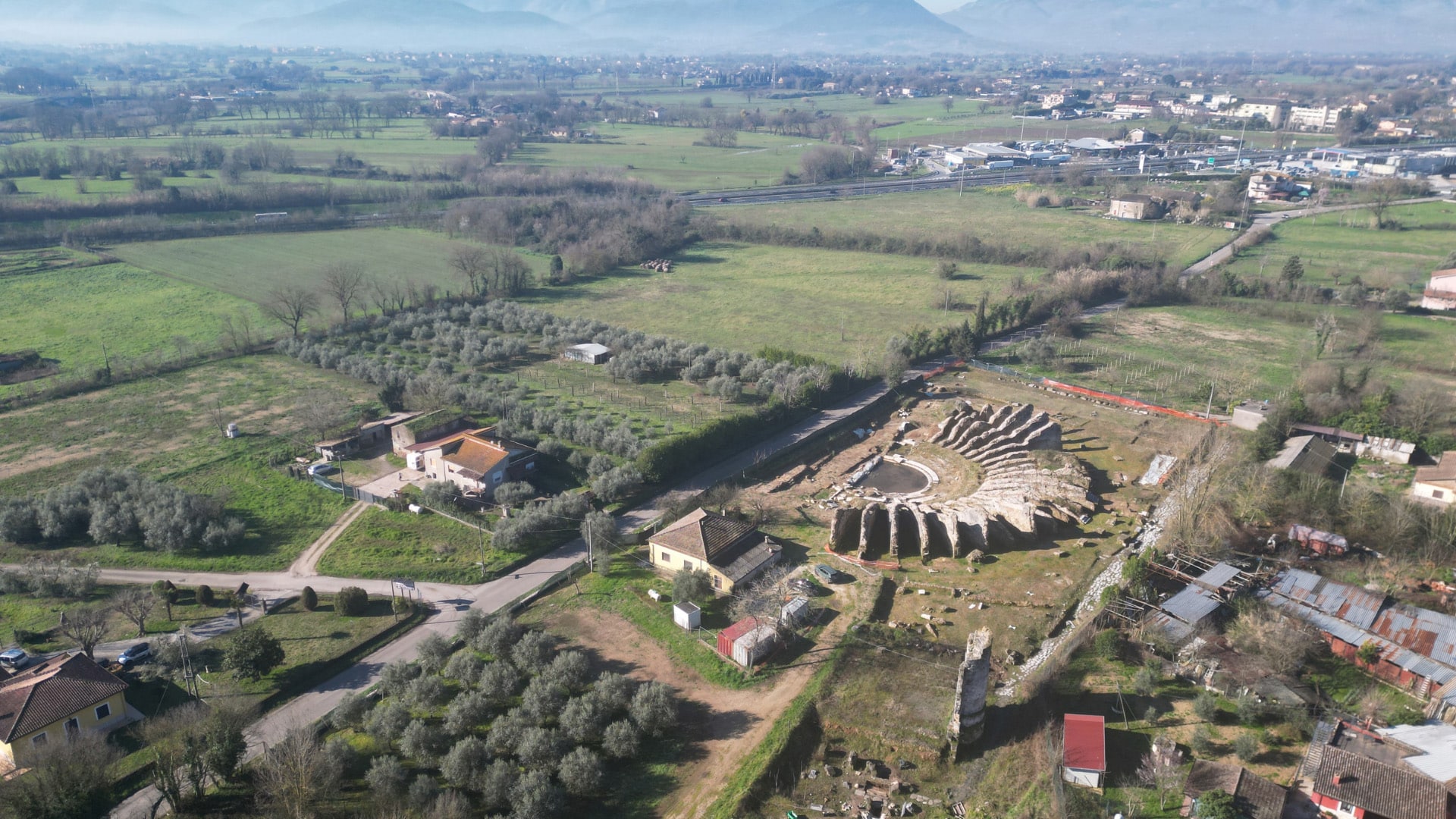
Head out of Rome south on the Via Casilina, and once you get past the architectural mélange of the periferia, Rome’s hinterland, the landscape drastically transforms into a bucolic countryside of farmhouses, ploughed fields, and the occasional tractor. At about 60 miles, you’ll want to slow down. What you can’t see, because it is not visible from the road, is the Roman city Aquinum.
Aquinum was a prosperous Roman city that once commanded this stretch of the road and the ancient Via Latina and the largest and most important Roman center on the Via Latina outside of Rome and Capua itself. The city lays claim to a who’s who of ancient Rome: birthplace of the satirist Juvenal, a center of purple dye production mentioned by Cicero, and the region that gave its name to Thomas Aquinas, born just five miles away in Roccasecca. After eighteen years of continuous excavation by University of Salento, just 20 of an estimated 250 acres have been investigated with the rest undisturbed beneath the ground. Today, Roma Sotterranea, recipient of an ECL Grant, is pushing that work further, into the city’s hidden underground infrastructure.
“There is something extraordinary about looking across those wide stretches of land, now cultivated and ploughed, and realizing that an entire city still lies underneath,” says Francesco Artibani, Project Director of Roma Sotterranea. “A city that, for the most part, will remain there, buried and preserved in the ground.”
Going Underground
What Roma Sotterranea does is not conventional archaeology. The organization, staffed entirely by volunteers with backgrounds in speleology, the science of cave exploration, specializes in the spaces that most excavations never reach: the drainage channels, cisterns, and inspection wells that form the invisible skeleton of a Roman city.
Since 2020, Roma Sotterranea has been working alongside the University of Salento at Aquinum, mapping the hydraulic infrastructure that kept the city alive. Between 2020 and 2023 alone, the team documented more than 790 feet of conduits beneath the Central Baths, mapping a labyrinth of channels and wells sealed for nearly two thousand years. Since 2024, the focus has shifted to the theater, which once seated 5,000 people and whose underground infrastructure remains almost entirely unknown. “The architecture tells us what the theater looked like,” Artibani explains. “What we are searching for underground can help us understand how it actually worked.”

A Season of Discoveries
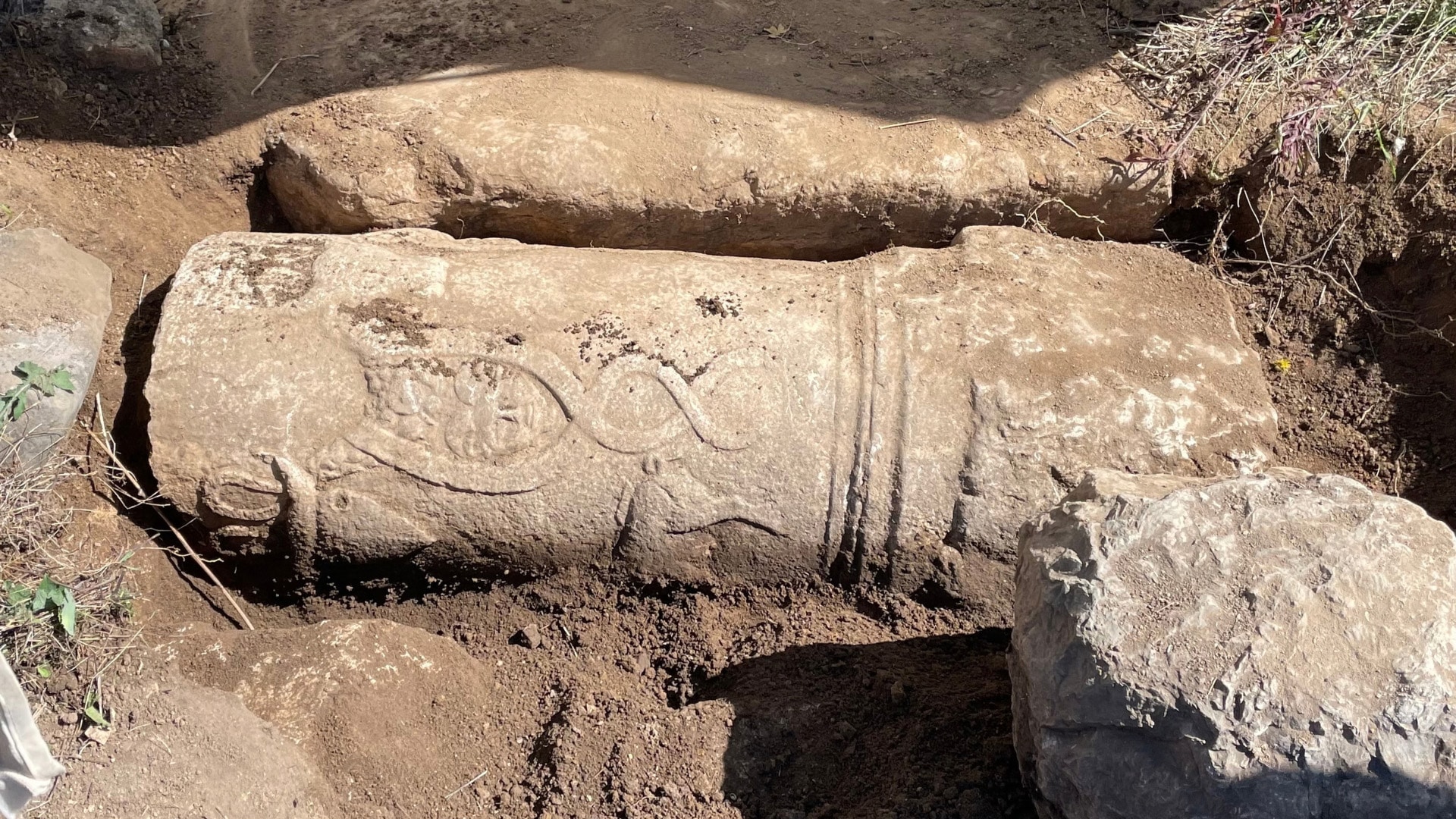
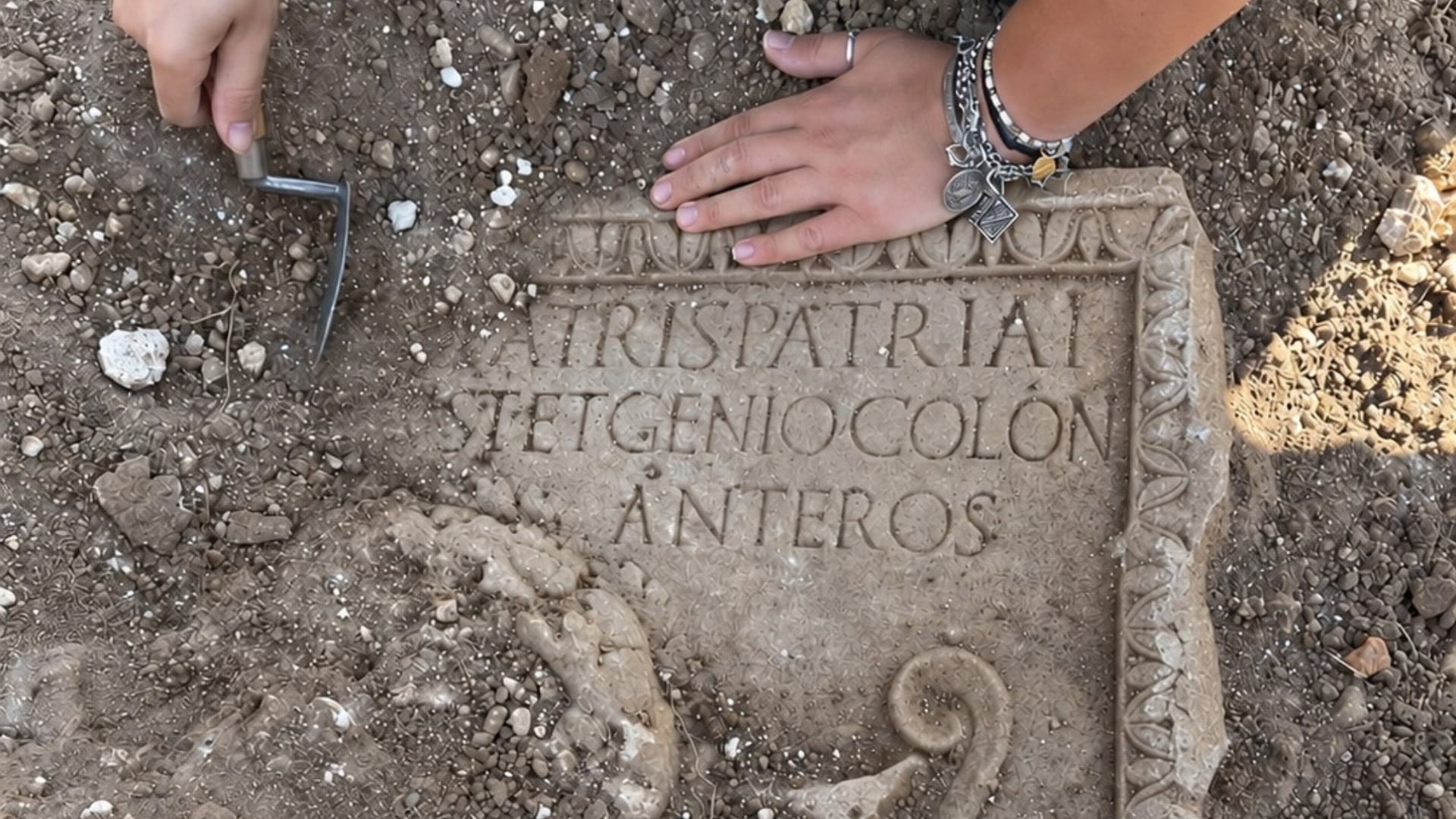
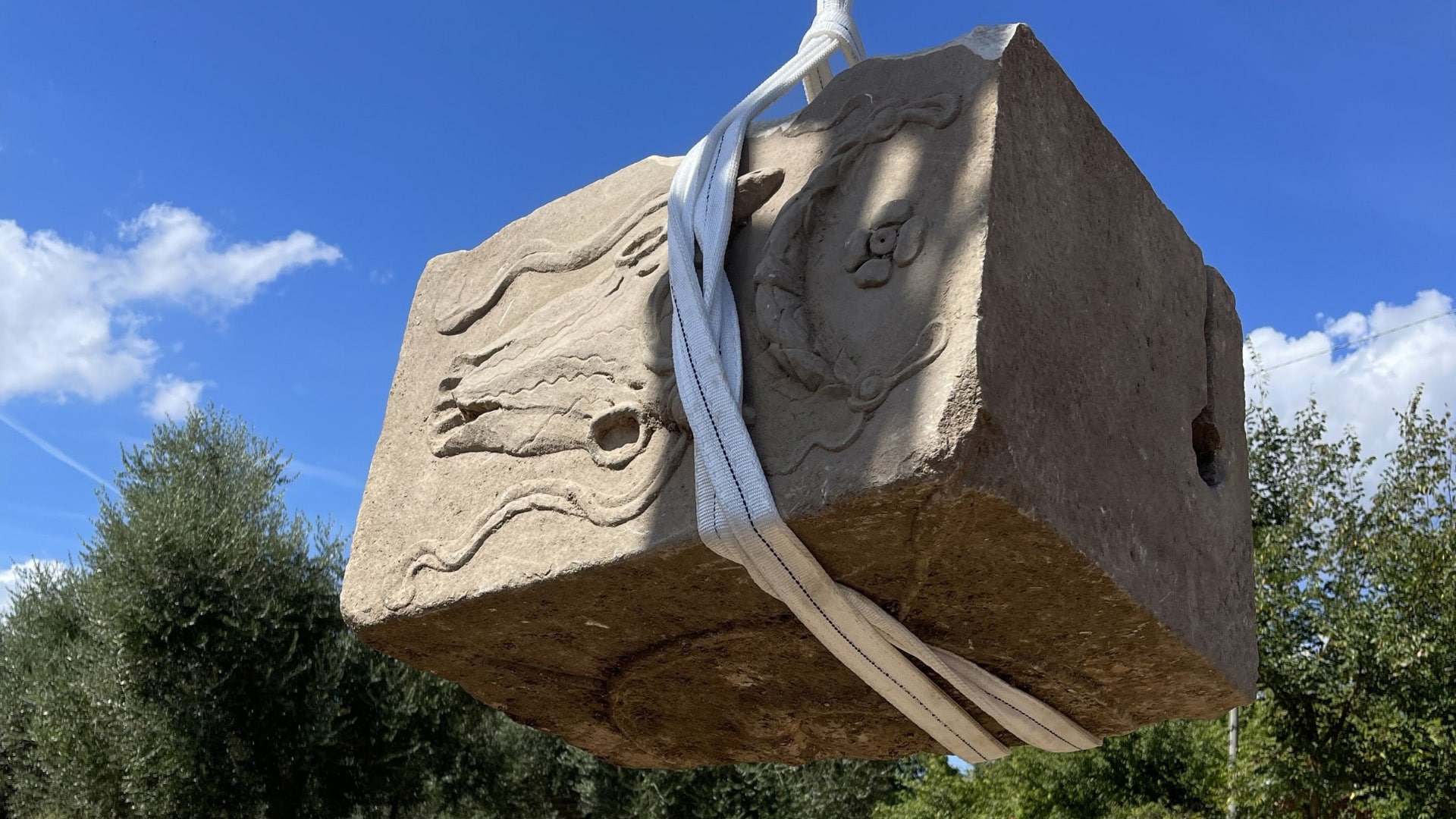
The 2026 season has produced some of the most remarkable finds in Aquinum’s excavation history: a carved stone cippus bearing the image of an ox, a ram, and a pig (the three animals of the suovetaurilia, one of Rome’s most solemn ritual sacrifices) reused as paving at a major crossroads; and a marble altar dedicated to the Genius of Augustus, paid for by Manius Popidius Anteros, a wealthy freedman who had risen to become a sevir Augustalis.
From the theater came another extraordinary find: a marble slab bearing the formula FVL(GVR) C[ONDITVM], “buried lightning” – the ritual inscription Romans used to consecrate a spot struck by lightning. The season also saw the restoration of five marble portrait heads, including the so-called Caesar of Aquinum. After eighteen years Aquinum still surprises.

A City with Stories Still to Tell
Aquinum’s significance extends well beyond its underground infrastructure. Juvenal mentioned the city in his Third Satire as a place to return to after the noise of Rome. Cicero referenced its purple dye production. Thomas Aquinas took his name from the counts of Aquino, whose castle stood just five miles away.
For ARL Director Darius Arya, the site’s greatest draw is precisely its untouched scale. “This is essentially a whole town to unearth in a series of farmers’ fields,” he says. “The preservation is exceptional and it is basically unexplored. That combination is extraordinarily rare in Roman archaeology.”

Technology in the Tunnels
Earlier this year, Roma Sotterranea located the main sewer collector at the intersection of the Cardo Maximus and Decumanus Maximus, a structure approximately 4.5 feet wide and more than 7 feet high, along with a hoard of 120 coins, inscriptions, and pottery. One significant discovery will be formally presented by the University and Italy’s Soprintendenza in the coming months.
“The site has already yielded an impressive bath complex with in situ mosaics of exceptional quality,” says Arya, who has been following the project since the Covid period and before the ECL grant. “I love the multidisciplinary team and their rapid progress. This is a project that will go the distance.”
The ECL Grant of $50,000 funded a robotic inspection system with a cable extending up to 330 feet and ground-penetrating radar surveys, two technologies that have transformed what a volunteer organization can achieve underground. “Without this support, it would have been very difficult to achieve the same results in the same amount of time,” Artibani says.
The Roman city of Aquinum will not be fully excavated in our lifetimes. But field by field, conduit by conduit, the picture is slowly coming into focus.
The Aquinum project is an ECL Grant recipient, funded by Ancient Rome Live. Learn more here.