
Official Name: POMPEIA PLOTINA CLAUDIA PHOEBE PISO AUGUSTA
Birthdate: Circa 70 CE.
Birthplace: Nemausus (modern-day Nîmes, France).
(Historia Augusta, Life of Hadrian, Part 1.12)
Reign: Trajan, Plotina’s husband, became emperor in 98 CE. She held the title of empress until his death in 117 CE.
(Cassius Dio, Roman History, 68.5 & 68.33)
Marriages:
Trajan (? – 117 CE)
(Cassius Dio, Roman History, 68.5 & 68.33)
Death: Plotina died of natural causes around 122 CE.
(Cassius Dio, Roman History, 69.10)
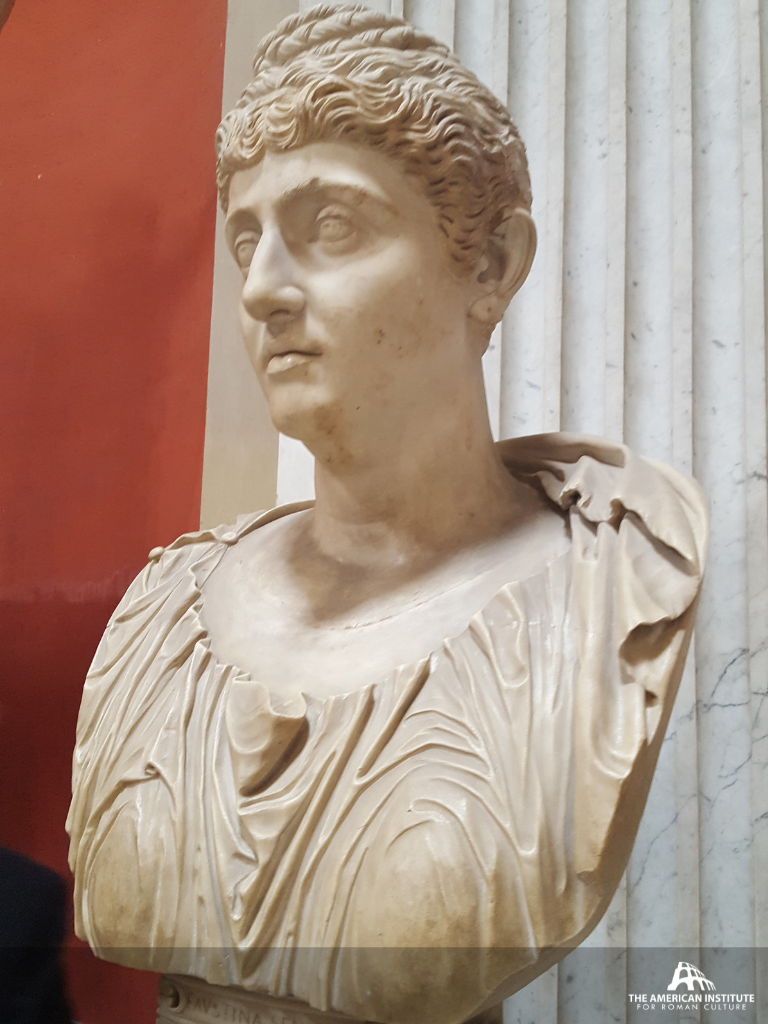
Head of Plotina set in a later bust, Vatican Museums, Vatican City, April 2017
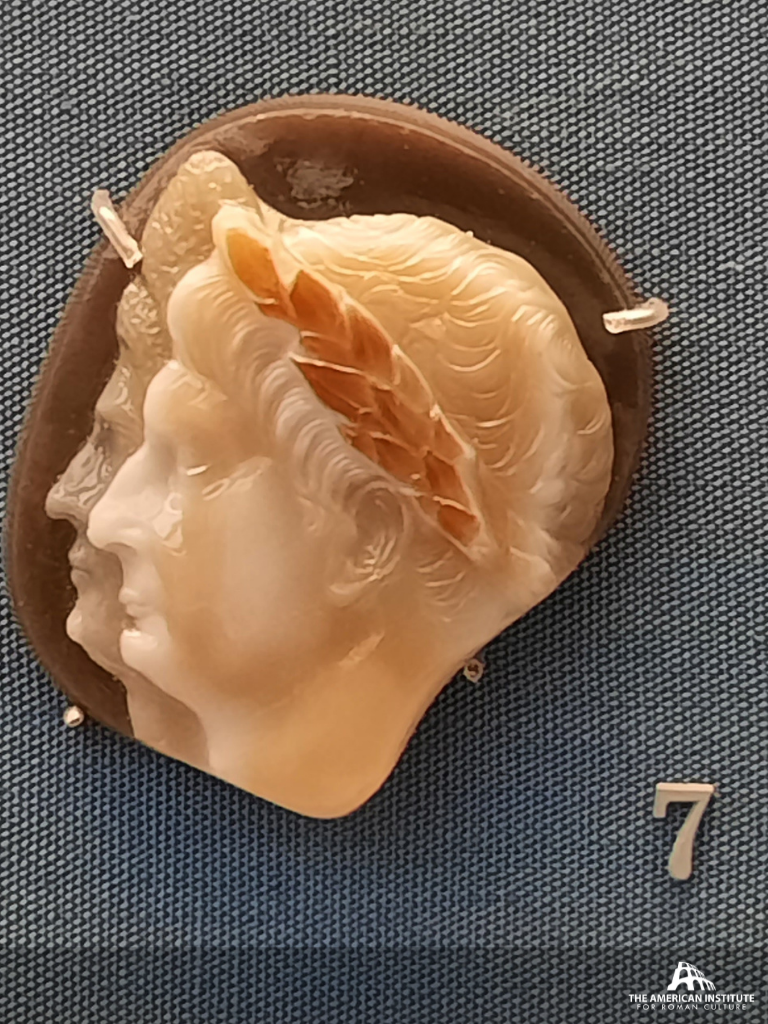
Plotina set in a Cameo with Trajan, British Museum, July 2nd 2021
Plotina was born into a prominent family and became one of the most respected empresses of the Roman Empire. Known for her intelligence, political judgment, and personal modesty, she helped reshape the public role of the empress during the reign of her husband, Emperor Trajan.
Plotina married Trajan long before his rise to power. When Trajan was adopted by Emperor Nerva in 97 CE and succeeded to the throne the following year, Plotina entered the center of Roman political life. Ancient sources recount that when Plotina first entered the imperial palace in Rome, she declared that she hoped to leave it the same person she had been when she entered. Whether historical or partly symbolic, the story reflects the reputation for humility and self-restraint for which she was known throughout her life.
Plotina’s influence extended beyond ceremonial duties. She was one of Trajan’s closest confidants and used her position to promote good governance and public welfare. Ancient writers credit her with opposing abuses by imperial officials and protecting provincial communities from exploitation. Her interest in Epicurean philosophy also shaped her support for education and intellectual life. Although she initially declined the title augusta, she eventually accepted the honor. Thereafter, her image appeared on imperial coinage, reflecting her prominent place within the imperial household.
Despite having no children of her own, Plotina played an important role in the succession politics of the early second century. She became a supporter of Hadrian, Trajan’s relative and eventual heir, and helped arrange his marriage to Trajan’s grandniece, Vibia Sabina. She was one of Hadrian’s most influential allies and supported his advancement through a series of important military and administrative appointments.
The defining moment of Plotina’s political life came in 117 CE. While returning from campaigns in the East, Trajan fell ill and died in Cilicia. Shortly afterward, it was announced that he had adopted Hadrian as his heir. Plotina and the praetorian prefect Attianus played central roles in managing the transition of power. Some ancient authors later claimed that Trajan’s adoption of Hadrian occurred only after the emperor’s death or that Plotina helped conceal Trajan’s death until the succession was secured. Modern historians debate these allegations, but there is little doubt that Plotina was instrumental in ensuring a smooth transfer of power at a potentially unstable moment for the empire.
Plotina died of natural causes around 122 CE. Hadrian honored her memory and had her deified, after which she was worshipped as Diva Plotina. He also commemorated her through public building projects and inscriptions, reflecting the respect and gratitude he held for the woman who had helped shape his rise to power.
Bibliography:
- Bennett, Julian. Trajan: Optimus Princeps. 2nd ed. London: Routledge, 2001.
- Birley, Anthony R. Hadrian: The Restless Emperor. London: Routledge, 1997.
- Boatwright, Mary Talia. “The Imperial Women of the Early Second Century A.C.” American Journal of Philology 112, no. 4 (1991): 513–540. https://doi.org/10.2307/294932.
- Roche, P. A. “The Public Image of Trajan’s Family.” Classical Philology 97, no. 1 (2002): 41–60. http://www.jstor.org/stable/1215545.
100
100
(Cassius Dio, Roman History, 69.1) (Historia Augusta, Life of Hadrian, Part 1.2 & Part 1.4)
122
(Historia Augusta, Life of Hadrian, Part 1.12) (Cassius Dio, Roman History, 69.10)
RIC II, Part 3 (second edition) Hadrian 1419-1420
This content is brought to you by The American Institute for Roman Culture, a 501(C)3 US Non-Profit Organization.
Please support our mission to aid learning and understanding of ancient Rome through free-to-access content by donating today.
Cite This Page
Cite this page as: Darius Arya, The American Institute for Roman Culture, “Plotina,” Ancient Rome Live. Last modified 06/20/2026. https://ancientromelive.org/plotina/
License
Created by The American Institute of Roman Culture, published on 12/10/2021 under the following license: Creative Commons: Attribution-NonCommercial-ShareAlike. This license lets others remix, tweak, and build upon this content non-commercially, as long as they credit the author and license their new creations under the identical terms. Please note that content linked from this page may have different licensing terms.