
Official Name: VIBIA SABINA AUGUSTA
Birthdate: Circa 80 CE.
Birthplace: Unknown.
Reign: Sabina’s husband Hadrian became emperor in 117 CE. She held the title of empress until her death around 137 CE.
(Historia Augusta, Life of Hadrian, 4 & 23) (RPC III 1546)
Marriages:
Hadrian (100 CE-137 CE)
(Historia Augusta, Life of Hadrian, 2 & 23)
Death: Sabina died of natural causes around 137 CE. Some sources suggest that Hadrian either poisoned his wife or drove her to suicide, but these accounts are generally regarded as rumors.
(Historia Augusta, Life of Hadrian, 23) (RPC III 1546) (Epitome De Caesaribus, Sextus Aurelius Victor, 150.8)
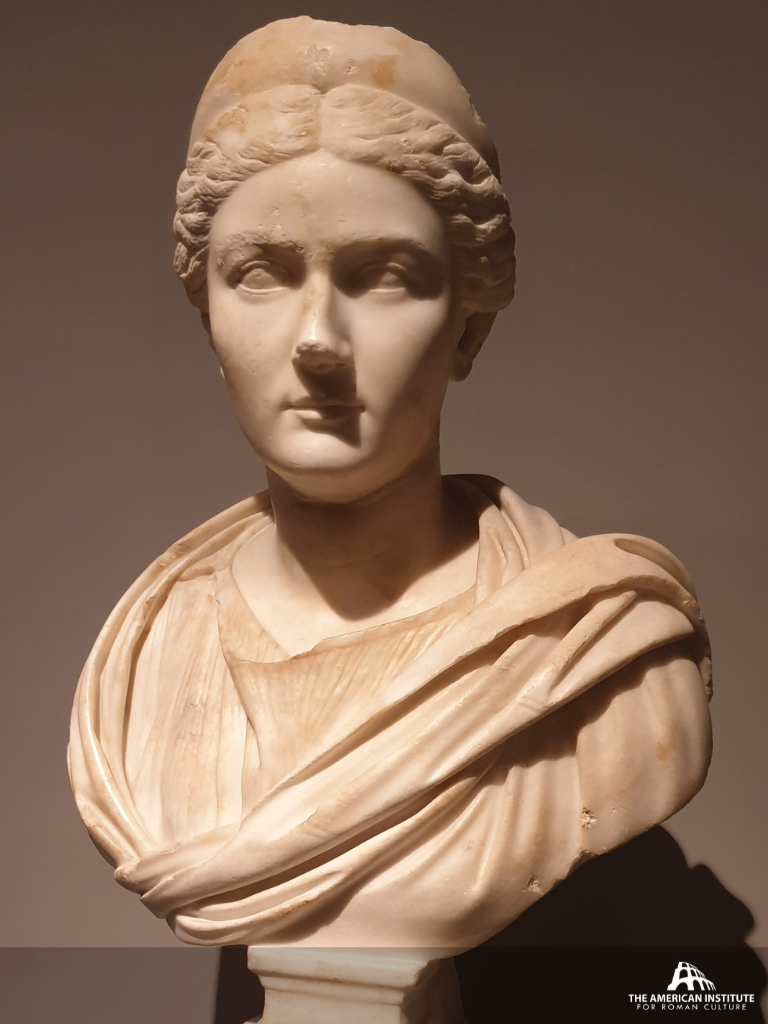
Bust of Sabina, Palazzo Massimo alle Terme, Rome, December 2018
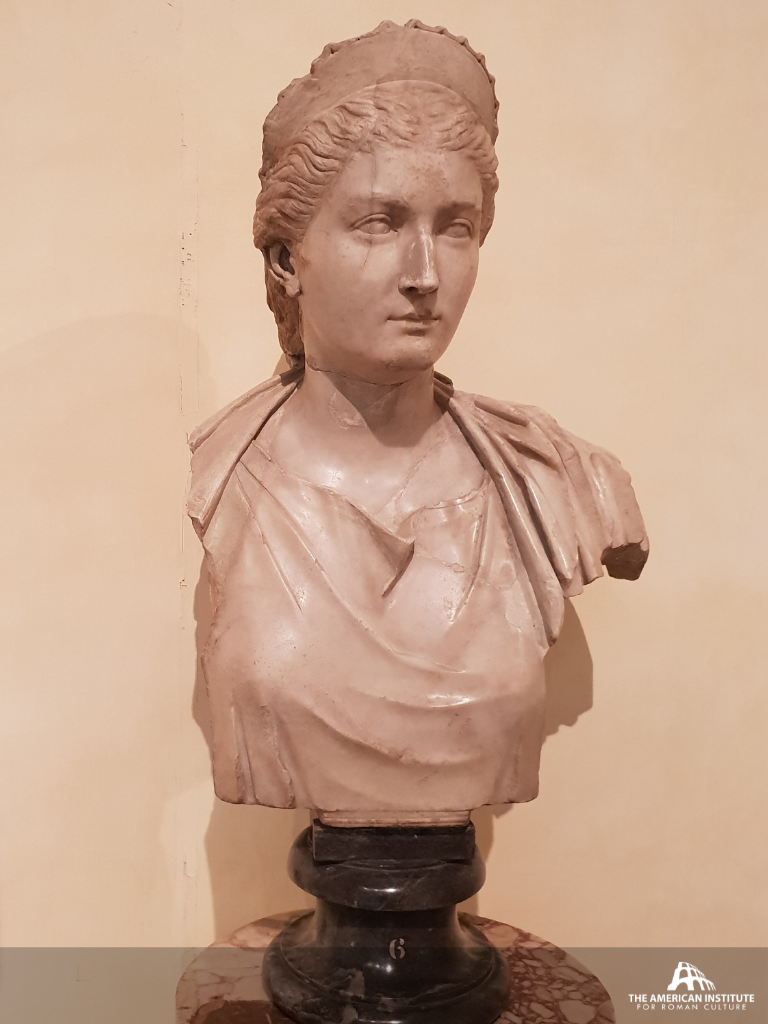
Bust of Sabina, Musei Capitolini, Rome, November 2018
Vibia Sabina, born around 80 CE, was a Roman empress whose family connections placed her at the heart of imperial power during the height of the Roman Empire. She was the daughter of Salonia Matidia, the niece of Emperor Trajan, and Lucius Vibius Sabinus. After her father’s early death, Sabina was raised within the household of her grandmother, Ulpia Marciana, and her great-uncle Trajan. Growing up among the imperial family made her an important figure in the dynastic politics of the age.
In 100 CE, Sabina married her cousin Hadrian, the future emperor. The marriage was likely arranged with the support of Empress Plotina, who saw political value in uniting Trajan’s grandniece with a rising member of the imperial family. The union strengthened Hadrian’s position within Trajan’s circle and later helped support his claim to the throne. Despite the political advantages the marriage offered, Sabina and Hadrian appear to have been incompatible. Ancient sources suggest that the marriage was not especially happy, and the couple never had children. This fueled court gossip and speculation about the stability of the imperial household, though neither partner ever moved to dissolve the marriage due to its dynastic importance.
When Hadrian became emperor in 117 CE following Trajan’s death, Sabina assumed the role of empress. She accompanied her husband on many of his extensive travels across the Roman Empire, a distinction few empresses of the period shared. In 128 CE, she received the prestigious title augusta, formally acknowledging her elevated position within the imperial household and the Roman state.
Sabina played an active role in the cultural life of the empire. During Hadrian’s famous visit to Egypt in 130 CE, she traveled with the poet Julia Balbilla, who commemorated the journey in inscriptions at the Colossi of Memnon. Sabina also supported civic projects and charitable activities, reflecting the public virtues expected of a Roman empress. Her conduct and public image echoed those of Plotina, one of the most respected imperial women of the era.
Vibia Sabina died in Rome in 136 or early 137 CE, only a short time before Hadrian’s own death. Although ancient writers portray the imperial marriage as troubled, Hadrian publicly honored her memory. He had her deified, and she was worshipped thereafter as Diva Sabina. Her remains were placed in Hadrian’s mausoleum, ensuring a permanent place for her among the imperial family she had served throughout her life.
Bibliography:
- Birley, Anthony R. Hadrian: The Restless Emperor. London: Routledge, 1997.
- Brennan, T. Corey. Sabina Augusta: An Imperial Journey. New York: Oxford University Press, 2018.
- Boatwright, Mary Talia. “The Imperial Women of the Early Second Century A.C.” American Journal of Philology 112, no. 4 (1991): 513–540. https://doi.org/10.2307/294932.
100
(Historia Augusta, Life of Hadrian, 11) (Cassius Dio, Roman History, 69.11)
119
(Historia Augusta, Life of Hadrian, 11)
137
(Apotheosis of Sabina – relief from the Arch of Portugal)
This content is brought to you by The American Institute for Roman Culture, a 501(C)3 US Non-Profit Organization.
Please support our mission to aid learning and understanding of ancient Rome through free-to-access content by donating today.
Cite This Page
Cite this page as: Darius Arya, The American Institute for Roman Culture, “Vibia Sabina,” Ancient Rome Live. Last modified 6/20/2026. https://ancientromelive.org/sabina/
License
Created by The American Institute of Roman Culture, published on 1/4/2022 under the following license: Creative Commons: Attribution-NonCommercial-ShareAlike. This license lets others remix, tweak, and build upon this content non-commercially, as long as they credit the author and license their new creations under the identical terms. Please note that content linked from this page may have different licensing terms.