
Roman Empress · 49–54 CE · Julio-Claudian dynasty
Official nameJulia Agrippina
BornNovember 6, 15 CE, Oppidum Ubiorum (modern Cologne, Germany)
(Tacitus, Annals, 12.27)
Empress49–54 CE, as wife of Claudius
(Tacitus, Annals, 12.1–7, 12.66–68)
ParentsGermanicus and Agrippina the Elder
MarriagesGnaeus Domitius Ahenobarbus (28–41), Gaius Sallustius Passienus Crispus (41–47), Claudius (49–54)
(Tacitus, Annals, 4.75, 12.1–7; Suetonius, Life of Nero, 5–6; Suetonius, Life of Passienus Crispus)
ChildrenNero (son by Gnaeus Domitius Ahenobarbus)
(Suetonius, Life of Nero, 5–6)
DeathMarch 23, 59 CE, at her villa near Bauli, killed on the orders of her son, Nero
(Tacitus, Annals, 14.8; Suetonius, Life of Nero, 34)
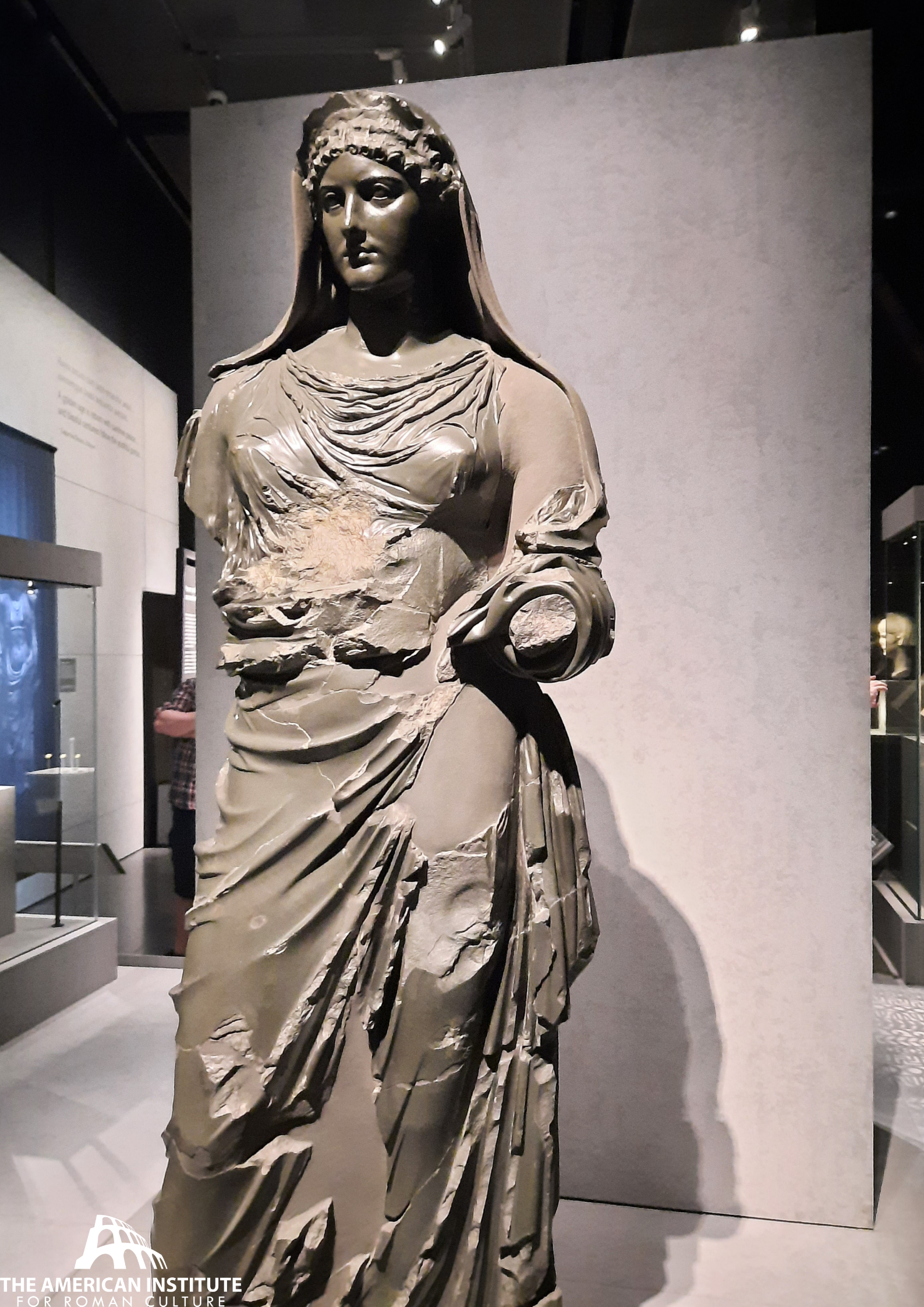
Basalt statue of Agrippina the Younger, Nero exhibition, British Museum, London
Born in 15 CE at the heart of Roman power, Agrippina the Younger was a princess of extraordinary lineage. She was the daughter of the celebrated general Germanicus and Agrippina the Elder, and the great-granddaughter of Emperor Augustus. She was also the sister of Emperor Caligula, the wife of Emperor Claudius, and the mother of Emperor Nero. Few women in Roman history were so closely connected to the imperial family.
Agrippina’s path to power was shaped by both privilege and tragedy. Her father died when she was still a child, and her mother and two of her brothers were later destroyed in the political struggles surrounding Emperor Tiberius. In 39 CE, her brother Caligula accused her and her sister Julia Livilla of involvement in a conspiracy against him. Agrippina was exiled to the Pontian Islands, where she remained until Caligula’s assassination in 41 CE. Her uncle Claudius then became emperor and allowed her to return to Rome.
Agrippina had a son from her first marriage to Gnaeus Domitius Ahenobarbus. Born in December 37 CE, he was named Lucius Domitius Ahenobarbus and would later become Emperor Nero. In 49 CE, Agrippina married her uncle Claudius. The marriage was controversial because Roman law prohibited marriage between an uncle and his niece, so the Senate approved a change in the law to make the union legal. Agrippina quickly became one of the most influential figures at the imperial court.
Agrippina played a central role in securing her son’s future. She arranged for the philosopher Seneca to return from exile and become Nero’s tutor. In 50 CE, she also helped secure Claudius’ adoption of Nero, placing him ahead of Claudius’ biological son, Britannicus, in the line of succession. Nero was subsequently given the name Nero Claudius Caesar and was presented as the emperor’s intended successor. Agrippina herself received the title Augusta, further elevating her public status.
When Claudius died suddenly in 54 CE, Nero became emperor at the age of sixteen. Ancient sources widely suspected that Claudius had been poisoned, and one famous account claimed that Agrippina used poisoned mushrooms to kill him.
During the early years of Nero’s reign, Agrippina’s political influence reached its height. She appeared alongside her son on coins and in official imagery, an extraordinary public representation for a Roman woman. She also exercised an unusual degree of influence over imperial affairs. Tacitus records that Senate meetings were held in the palace so that Agrippina could listen from behind a curtain. On another occasion, Agrippina attempted to join Nero as he received envoys from Armenia, but Seneca intervened to prevent what would have been an extraordinary breach of Roman convention.
Agrippina’s influence eventually became a source of conflict with her son. As Nero sought greater independence, their relationship deteriorated. Ancient sources portray Agrippina as increasingly determined to maintain her authority, while Nero came to regard her influence as a threat. In 59 CE, he ordered a complicated attempt to kill her by arranging for her to travel on a specially constructed ship designed to collapse at sea. The plot failed, and Agrippina survived the wreck and reached her villa. Nero then sent soldiers to finish the task. Agrippina was killed at her villa near Bauli in March 59 CE.
Agrippina’s legacy has been shaped by hostile ancient accounts and Roman anxieties about powerful women. Modern scholarship, however, offers a more nuanced view, using coins, portraits, inscriptions, and other evidence to reveal a politically influential woman who held an extraordinary position at the heart of the Roman Empire.
Bibliography
- Barrett, Anthony A. Agrippina: Sex, Power, and Politics in the Early Empire. Yale University Press, 1996.
- Boatwright, Mary T. Agrippina the Younger: A Dangerous Woman in Rome’s Early Empire. Oxford University Press, 2026.
- Boatwright, Mary T. Imperial Women of Rome: Power, Gender, Context. Oxford University Press, 2021.
- Ginsburg, Judith. Representing Agrippina: Constructions of Female Power in the Early Roman Empire. Oxford University Press, 2005.
15 CE
Born on November 6 at Oppidum Ubiorum (modern Cologne).
(Tacitus, Annals, 12.27)
39 CE
Exiled to the Pontian Islands after a plot against her brother, Caligula.
(Suetonius, Life of Caligula, 24)
49 CE
Marries her uncle, Emperor Claudius, after the Senate changes the law.
(Tacitus, Annals, 12.5–7)
50 CE
Secures Claudius’ adoption of her son, Nero, ahead of Britannicus.
(Tacitus, Annals, 12.25–26)
54 CE
Claudius dies, reputedly poisoned; Nero becomes emperor at sixteen.
(Tacitus, Annals, 12.66–69)
59 CE
Killed at her villa near Bauli on Nero’s orders after a failed shipwreck plot.
(Tacitus, Annals, 14.3–8)

This content is brought to you by The American Institute for Roman Culture, a 501(C)3 US Non-Profit Organization.
Please support our mission to aid learning and understanding of ancient Rome through free-to-access content by donating today.
Join our free newsletter to receive more ancient Rome content, lecture and Masterclass invites, travel course news and more:
Cite this page as: Ancient Rome Live, The American Institute for Roman Culture, “Agrippina the Younger“. Last modified
November 16, 2026. https://ancientromelive.org/agrippina/
Created by The American Institute of Roman Culture, published on
November 22, 2021 under the following license: Creative Commons: Attribution-NonCommercial-ShareAlike. This license lets others remix, tweak, and build upon this content non-commercially, as long as they credit the author and license their new creations under the identical terms. Please note that content linked from this page may have different licensing terms.