
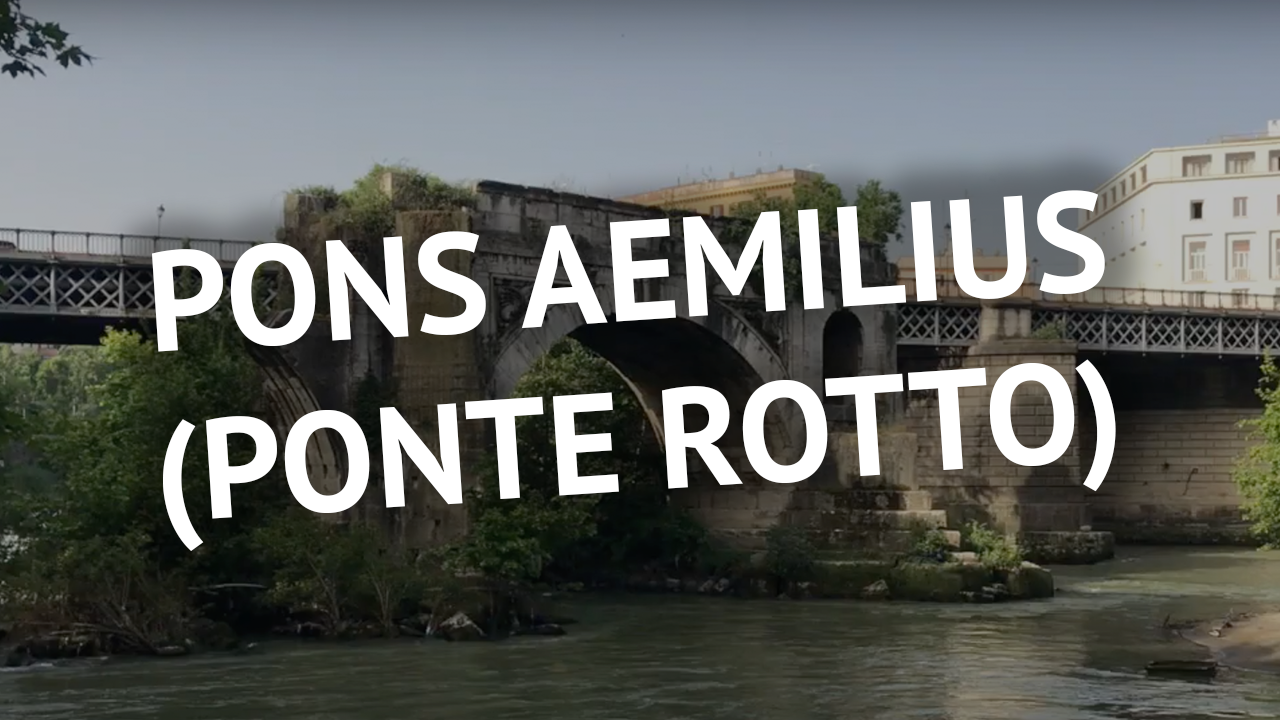

The Pons Aemilius, known in Italian as Ponte Emilio and more commonly as Ponte Rotto (“the Broken Bridge”), is one of the oldest stone bridges in Rome. Today, only a single arch survives, standing alone in the Tiber as a striking reminder of Roman engineering skill.
The bridge originally connected the Forum Boarium with Trastevere and was part of Rome’s early river-crossing infrastructure. Although several arches remained standing into the Middle Ages, repeated flooding gradually weakened the structure. Three arches survived until the nineteenth century, when they were demolished during the construction of modern flood walls along the Tiber. What remains is a single, imposing arch that still conveys the scale and durability of the original bridge.
The earliest version of the Pons Aemilius was likely built in the mid-3rd century BCE, around the time the Via Aurelia was laid out. This first bridge was wooden. The transition to stone began in 179 BCE, when the censors Marcus Fulvius Nobilior and Marcus Aemilius Lepidus initiated construction of Rome’s first stone bridge across the Tiber (Livy 40.51.4). Because it was such an ambitious and unprecedented project, construction progressed slowly. The stone piers date to this phase, while the upper structure likely remained wooden.
The bridge’s stone arches were added in 142 BCE by Scipio Aemilianus and Lucius Mummius, completing the transformation into a fully stone structure (Livy 40.51.4). During the reign of Augustus, the bridge was completely rebuilt using a core of tufa and concrete. This Augustan reconstruction featured six large arches, along with two smaller arches at either end to support the approach ramps.
Over the centuries, the Pons Aemilius required frequent repairs. It was restored under Emperor Probus in 280 CE, and again in 1230 and 1557. Despite these efforts, a major flood in 1598 swept away the eastern half of the bridge. The remaining arches were ultimately demolished in the 1880s during modern redevelopment of the riverbanks. An inscription from the 1557 restoration, carried out under Pope Gregory XIII, is still preserved on the surviving arch.
Today, the best views of Ponte Rotto can be enjoyed from the Ponte Palatino and from the southern tip of Tiber Island.
Bibliography:
- Grout, James. “Pons Aemilius.” University of Chicago. https://penelope.uchicago.edu/encyclopaedia_romana/romanurbs/ponsaemilius.html
- Harmanşah, Ömür and Lothar Haselberger. “Pons Aemilius.” Digitial Augustan Rome. https://www.digitalaugustanrome.org/records/pons-aemilius/
- Platner, Samuel. (1929). “Pons Aemilius.” In A Topographical Dictionary of Ancient Rome (p.397-398). Retrieved from: https://penelope.uchicago.edu/Thayer/E/Gazetteer/Places/Europe/Italy/Lazio/Roma/Rome/_Texts/PLATOP*/Pons_Aemilius.html
- “Ponte Rotto (Pons Aemilius).” The Metropolitan Museum of Art. https://www.metmuseum.org/art/collection/search/726476

PONS AEMILIUS, the official name of the first stone bridge across the Tiber. According to Livy (xl. 51. 4) M. Fulvius Nobilior when censor in 179 B.C. contracted (undoubtedly with his colleague M. Aemilius Lepidus) for the placing of ‘pilas pontis in Tiberi,’ and P. Scipio Africanus and L. Minucius, the censors of 142 B.C., built arches (fornices) on these piers.
Read more:
This statement is now generally believed to refer to the pons Aemilius, and Plutarch’s attribution of the building of the bridge to a quaestor, Aemilius, is interpreted as a mistake or on the hypothesis that the fornices of 142 were of wood and that the stone arches were laid by a later Aemilius in his quaestorship. That the upper part of the bridge was of wood, until 142 at least, is certain, and therefore a statement in Obsequens (16) under date of 156 B.C., pontis maximi tectum cum columnis in Tiberim deiectum, is cited as evidence that pons maximus was then a name in common use, although Mommsen’s conjecture pontificis may be correct.
In the fourteenth century an arch was standing in the forum Boarium in front of the Ponte Rotto described as arcus marmoreus in platea pontis S. Mariae (Anon. Magl. 155), on which was an inscription (CIL vi. 878) referring to a restoration by Augustus after 12 B.C. It is possible that this restoration may have been that of the bridge. Besides pons S. Mariae (LS ii. 22-28; iv. 49, 84) this bridge was called in the Middle Ages pons Senatorum (Mirab. II), and pons Maior (Eins. 7. 4; cf. Delbruck, Hellenistische Bauten i. 14). In the seventh century Aethicus (loc. cit.) writes: pontem Lepidi qui nunc abusive a plebelapideus dicitur iuxta forum boarium transiens. Both these early variants of Aemilius are easily explained, Lepidi from Aemilius, and lapideus from the tradition that it was the first stone bridge (Plut. loc. cit.). The identification of the pons Aemilius of the empire with the present Ponte Rotto may be regarded as certain. This bridge was partially destroyed by the flood of 1557 (cf. M61. 1906, 189-193) and repaired by Gregory XIII (III. 37). In 1598 the eastern half was carried away, and in 1887 two of the three remaining arches were removed, so that only one now stands in midstream. Recent investigation has shown that the ancient pier of this arch is not the earliest, as the remains of the abutment are earlier and belong to a bridge slightly further north which crossed the river at a slightly different angle. This was therefore the bridge of the second century B.C. and the existing arch and pier belong to a second structure, probably that of Augustus (Delbrfick, op. cit. i. 12-22 ; ii. taf. 2 ; Richter, Befestigung d. Ianiculums 18-20; Jord. i. I. 409-414; 420-421; RE i. 593; M61. 1906, 180-181, 189-193 ; Gilb. iii. 257-260 ; Ber. d. sachs. Gesell. 1850, 320-326; Besnier 128-130; BC 1914, 390; DuP 58, and fig. 31; TF 139-141). Cf. Ill. 32: and see FORNIX AUGUSTI.
For a viaduct on the road leading from the bridge to the Janiculum, cf. VIA AURELIA.
This content is brought to you by The American Institute for Roman Culture, a 501(C)3 US Non-Profit Organization.
Please support our mission to aid learning and understanding of ancient Rome through free-to-access content by donating today.
Cite This Page
Cite this page as: Darius Arya, The American Institute for Roman Culture, “Pons Aemilius (Ponte Rotto),” Ancient Rome Live. Last modified 01/24/2026. https://ancientromelive.org/pons-rotto/
License
Created by The American Institute of Roman Culture, published on 10/24/2019 under the following license: Creative Commons: Attribution-NonCommercial-ShareAlike. This license lets others remix, tweak, and build upon this content non-commercially, as long as they credit the author and license their new creations under the identical terms. Please note that content linked from this page may have different licensing terms.
