
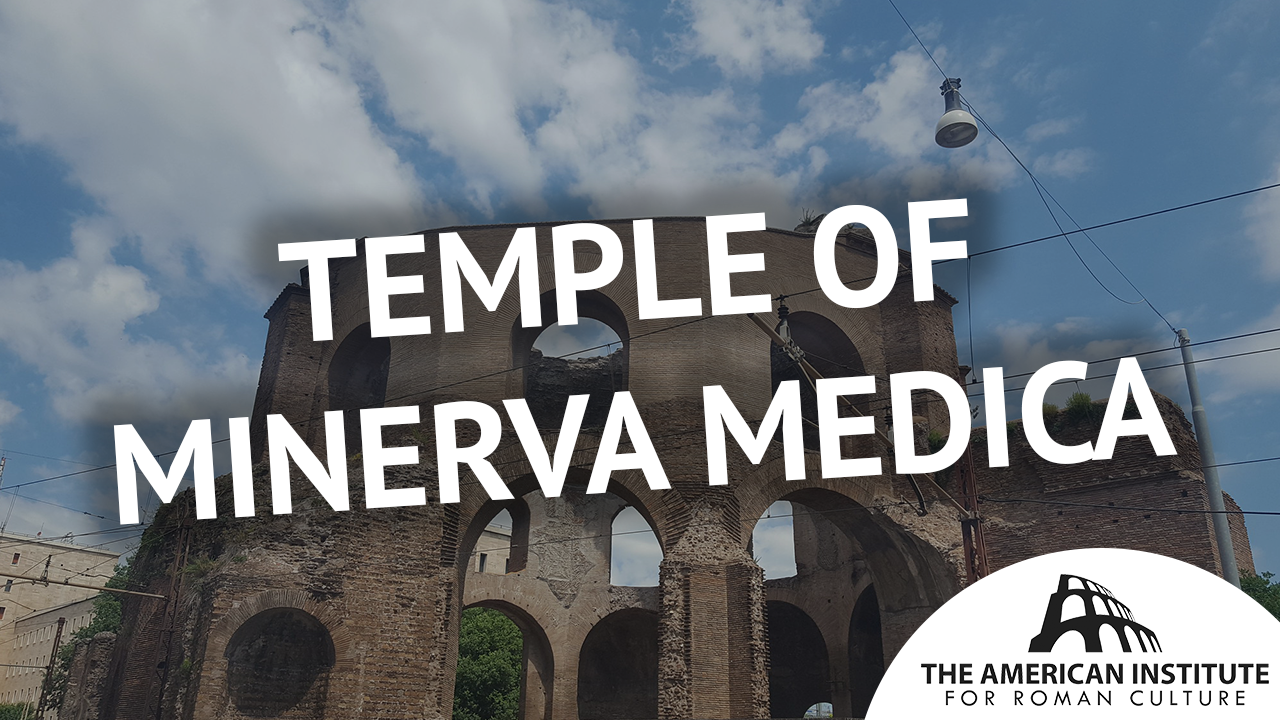

The so-called Temple of Minerva Medica stands near the railway tracks close to the Termini station on the Esquiline Hill. Despite its traditional name, the building was almost certainly not a temple dedicated to the goddess Minerva.
Scholars have proposed several explanations for the monument’s original function. It may have been a nymphaeum (a monumental fountain) or a grand dining hall. Whatever its purpose, the structure was part of the imperial estates located in the luxurious suburban gardens known as the horti. The building appears to have stood within the Horti Liciniani.
The monument’s construction date is uncertain. Because the nearby Circus Varianus was built during the Severan Dynasty, some scholars believe the structure may originally have been constructed during that period. However, brick stamps found in the building date to the reign of Constantine. This suggests that the monument may have been built or extensively rebuilt in the early 4th century CE, possibly in connection with the nearby Sessorian Palace established by Helena. At that time, several imperial estates in the area may have been combined into a single large complex of gardens.
Architecturally, the building was an impressive domed hall. It measured about 24 meters in diameter and, with its dome, reached a height of roughly 33 meters. Constructed from brick-faced concrete, the structure was designed as a free-standing decagonal hall. Inside, nine semicircular niches lined the walls, while the tenth side contained the main entrance. Above these openings were ten large windows that helped illuminate the interior.
The concrete dome, supported by a system of brick ribs, collapsed in the 19th century. Before its collapse, it was one of the largest domes in ancient Rome, smaller only than those of the Pantheon and the caldarium of the Baths of Caracalla.
Archaeological evidence suggests that the structure proved structurally ambitious. According to the archaeologist Amanda Claridge, major reinforcements were added not long after construction:
“The lightness of the structure was evidently rather too daring: about twenty years after it was built, large wedge-shaped buttresses were stacked against the east and west sides… and further buttressed by an outer semicircular exhedra; two large rectangular buttresses were also placed against the south wall, and the entrance side was given a porch.”
(Claridge, Rome: An Oxford Archaeological Guide, p.390).
These buttresses helped stabilize the building, while the exhedra may also have expanded the usable interior space, perhaps for dining or ceremonial functions.
The interior was richly decorated. Archaeological remains show that the walls were once covered with opus sectile marble veneer and glass-paste mosaics, features typical of luxurious imperial buildings. Excavations have also uncovered a furnace and hypocaust system, indicating that the room was heated and could be used during colder months.
The niches in the walls were designed to hold statues. Two sculptures discovered at the site, dating to around 400 CE, are now displayed in the Centrale Montemartini. They depict a father and son serving as magistrates, each shown throwing the mappa (a ceremonial cloth) used to signal the start of a race in the circus.
The building acquired its modern name in the 17th century, when antiquarians mistakenly identified it as a temple to Minerva. This misidentification was based on sacred objects and votive offerings discovered nearby, which were assumed to be connected to the structure.
The monument has been recently restored and remains one of the most unusual surviving buildings from late antiquity in Rome. Although its original purpose is still debated, it provides a striking example of the architectural ambition and luxury associated with the imperial gardens on the Esquiline Hill.
Bibliography:
- Claridge, Amanda. Rome: An Oxford Archaeological Guide. 2nd ed. Oxford: Oxford University Press, 2010.
- Lanciani, Rodolfo. Pagan and Christian Rome. Boston: Houghton, Mifflin and Company, 1892.
- “Nymphaeum, ‘Temple of Minerva Medica’: Overall View.” University of Notre Dame. https://marble.nd.edu/item/af09faab-1513-44e1-bbfe-c33abfda4d7e
- Platner, Samuel. “Nymphaeum.” In A Topographical Dictionary of Ancient Rome (pp.363‑364). London: Oxford University Press, 1929. Retrieved from: https://penelope.uchicago.edu/Thayer/E/Gazetteer/Places/Europe/Italy/Lazio/Roma/Rome/_Texts/PLATOP*/Nymphaeum.html#Nymphaeum_2_photo
On the Esquiline, between the via Labicana and the Aurelian wall, just inside the line of the Anio vetus. There is no mention of this structure in ancient literature or inscriptions, but it is without doubt a monumental nymphaeum. The existing ruins consist of a decagonal hall of opus latericium, which was covered with a domed roof until part of it fell in 1828, surrounded on three sides with other chambers added at a later date. In the interior of the hall are nine niches, besides the entrance; and above these are ten corresponding round-arched windows. The diameter of the hall is about 24 metres, and the height was 33. It is very important from the structural point of view, and especially for the meridian ribs in the dome. The outside walls were covered with marble and the interior richly decorated in a similar manner.
Read more:
In the fifteenth century Flavius Blondus (Roma Instaurata) called these ruins Le Galluzze, a name of uncertain meaning that had been applied earlier to some ruins near S. Croce in Gerusalemme (Jord. II.130‑131). Since the seventeenth century the nymphaeum has frequently been called Templum Minervae Medicae (q.v.), on account of the erroneous impression that the Giustiniani Athene had been found in its ruins (HJ 360; LS III.158‑161). It is now often attributed to the Horti Liciniani, but without adequate reason.
This content is brought to you by The American Institute for Roman Culture, a 501(C)3 US Non-Profit Organization.
Please support our mission to aid learning and understanding of ancient Rome through free-to-access content by donating today.
Cite This Page
Cite this page as: Darius Arya, The American Institute for Roman Culture, “Temple of Minerva Medica,” Ancient Rome Live. Last modified 3/16/2026. https://ancientromelive.org/temple-of-minerva-medica/
License
Created by The American Institute of Roman Culture, published on 06/19/2020 under the following license: Creative Commons: Attribution-NonCommercial-ShareAlike. This license lets others remix, tweak, and build upon this content non-commercially, as long as they credit the author and license their new creations under the identical terms. Please note that content linked from this page may have different licensing terms.
