Official Name: IMPERATOR TITUS CAESAR VESPASIANUS AUGUSTUS
Birthdate: December 30, 39 CE
(Cassius Dio, Roman History, 66.17)
Birthplace: Rome, Italy
(Suetonius, Life of Titus, 1)
Reign: Named emperor in the will of his father and predecessor, Vespasian, who died on June 24, 79 CE.
(Cassius Dio, Roman History, 66.18)
Marriages:
Arrecina Tertulla
(Suetonius, Life of Titus, 4)
Marcia Furnilla
(Suetonius, Life of Titus, 4)
Children:
Julia Flavia (daughter by Marcia Furnilla)
(Suetonius, Life of Titus, 4)
Death:
Titus died on September 13, 81 CE. Most sources agree that Titus died of natural causes, but some suggest that his brother, Domitian, played a role in his death.
(Suetonius, Life of Titus, 10-11) (Cassius Dio, Roman History, 66.26)
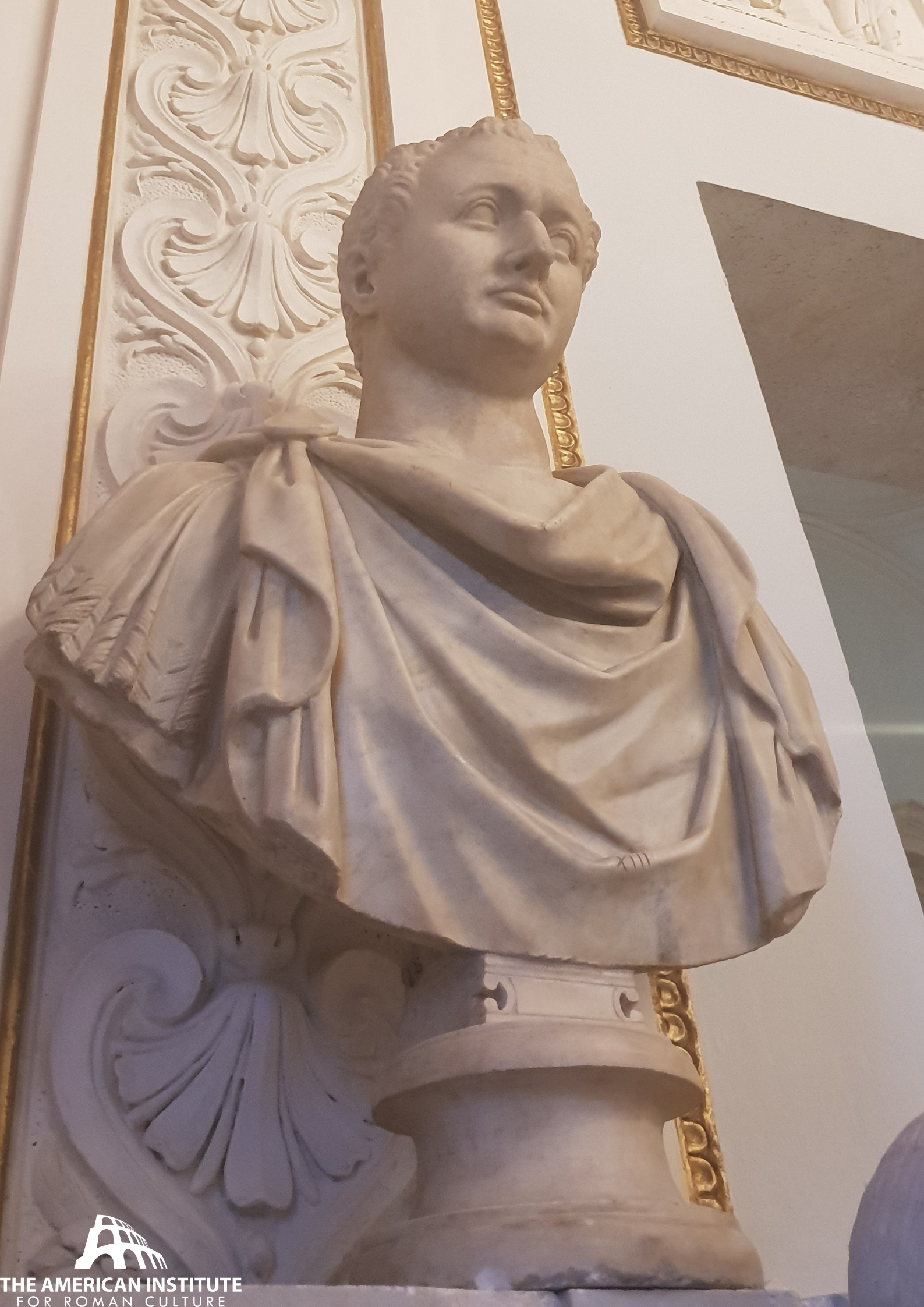
Bust of Titus, Musei Capitolini, Rome, November 2018.
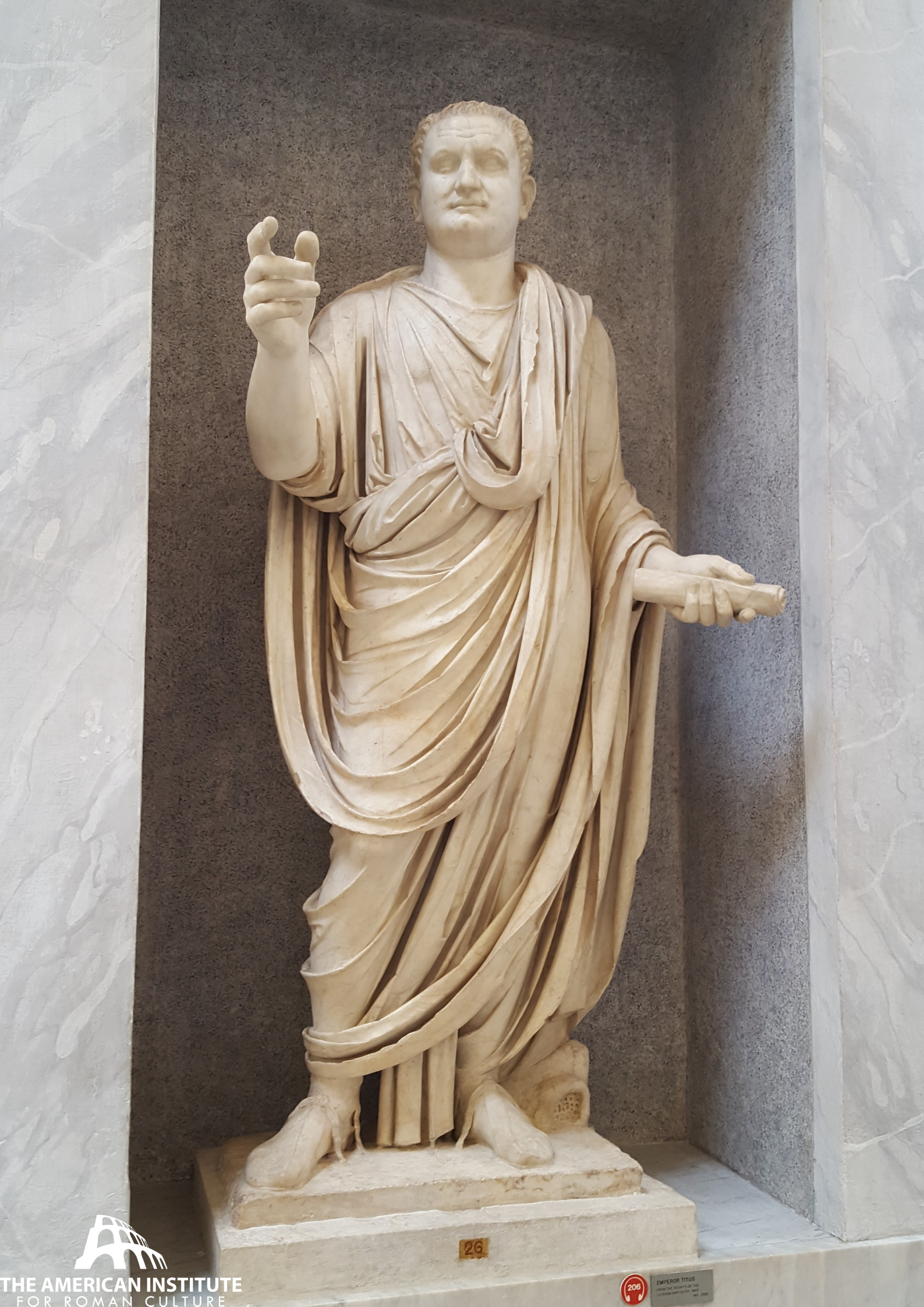
Statue of Titus, Musei Vaticani, Vatican City, April 2017.
Titus was born on December 30, 39 CE, the eldest son of the future emperor Vespasian and Domitilla the Elder. He was raised at the imperial court alongside Britannicus, the son of Emperor Claudius. Titus received an excellent education in poetry, law, and military strategy, and later served as a military tribune in Germany and Britain.
In 67 CE, Titus went east to join his father, who was commanding Roman troops during the Great Jewish Revolt. After Vespasian departed for Rome, Titus was left in command of the campaign in Judea. In 70 CE, he successfully besieged Jerusalem, a campaign that ended with the destruction of the Second Temple. When Titus returned to Rome in 71 CE, he was formally recognized as heir to the throne and appointed commander of the Praetorian Guard.
During this period, Titus developed a mixed reputation. Some viewed him as harsh and ambitious, while others criticized his highly public relationship with the Jewish queen Berenice. However, after becoming emperor on June 24, 79 CE, Titus quickly transformed public opinion and earned a reputation for generosity and moderation. Ancient writers even called him “the favorite of mankind.”
Titus’s reign was marked by several disasters that tested his leadership. Just two months after he became emperor, the eruption of Mount Vesuvius in August 79 CE destroyed the cities of Pompeii and Herculaneum. Titus responded by personally overseeing relief efforts and providing substantial financial aid to survivors.
In 80 CE, Rome suffered a devastating fire followed by a plague. Once again, Titus directed recovery efforts and reportedly used his own resources to support rebuilding projects instead of relying on the confiscation of private property. These actions greatly increased his popularity among the Roman people.
Titus also completed several major public works begun during his father’s reign. He inaugurated the Colosseum in 80 CE with one hundred days of games and spectacles and constructed the Baths of Titus. He also helped establish a model of stable hereditary succession. Titus became the first biological son to succeed his father as Roman emperor, bringing a period of stability to the imperial office.
Titus’s reign ended abruptly in 81 CE when he fell ill with a fever while traveling to the family villa in the Sabine Hills. He died on September 13, 81 CE, at the age of 41, after ruling for just over two years. According to tradition, his final words were, “I have only made one mistake,” though historians still debate what he meant. After his death, Titus was deified by the Senate and succeeded by his younger brother, Domitian.
Bibliography:
- Bastomsky, S. J. “The Death of the Emperor Titus – A Tentative Suggestion.” Apeiron: A Journal for Ancient Philosophy and Science 1, no. 2 (1967): 22–23. http://www.jstor.org/stable/40891400.
- Crook, John A. “Titus and Berenice.” The American Journal of Philology 72, no. 2 (1951): 162–75. https://doi.org/10.2307/292544.
- Jones, Brian W. The Flavians. London: Routledge, 1992.
- Jones, Brian W. “Titus in Judaea, A.D. 67.” Latomus 48, no. 1 (1989): 127–34. http://www.jstor.org/stable/41541032.
- Jones, Brian W. “Titus in the East, A.D. 70-71.” Rheinisches Museum Für Philologie 128, no. 3/4 (1985): 346–52. http://www.jstor.org/stable/41233560.
- Levick, Barbara. The Emperor Titus. London: Routledge, 1999.
70
(Josephus, The War of the Jews, 6.6)
79
(Suetonius, Life of Titus, 8)
80
(Cassius Dio, Roman History, 66.25)
This content is brought to you by The American Institute for Roman Culture, a 501(C)3 US Non-Profit Organization.
Please support our mission to aid learning and understanding of ancient Rome through free-to-access content by donating today.
Cite This Page
Cite this page as: Darius Arya, The American Institute for Roman Culture, “Titus,” Ancient Rome Live. Last modified 05/28/2026. https://ancientromelive.org/titus/
License
Created by The American Institute of Roman Culture, published on 07/15/2021 under the following license: Creative Commons: Attribution-NonCommercial-ShareAlike. This license lets others remix, tweak, and build upon this content non-commercially, as long as they credit the author and license their new creations under the identical terms. Please note that content linked from this page may have different licensing terms.