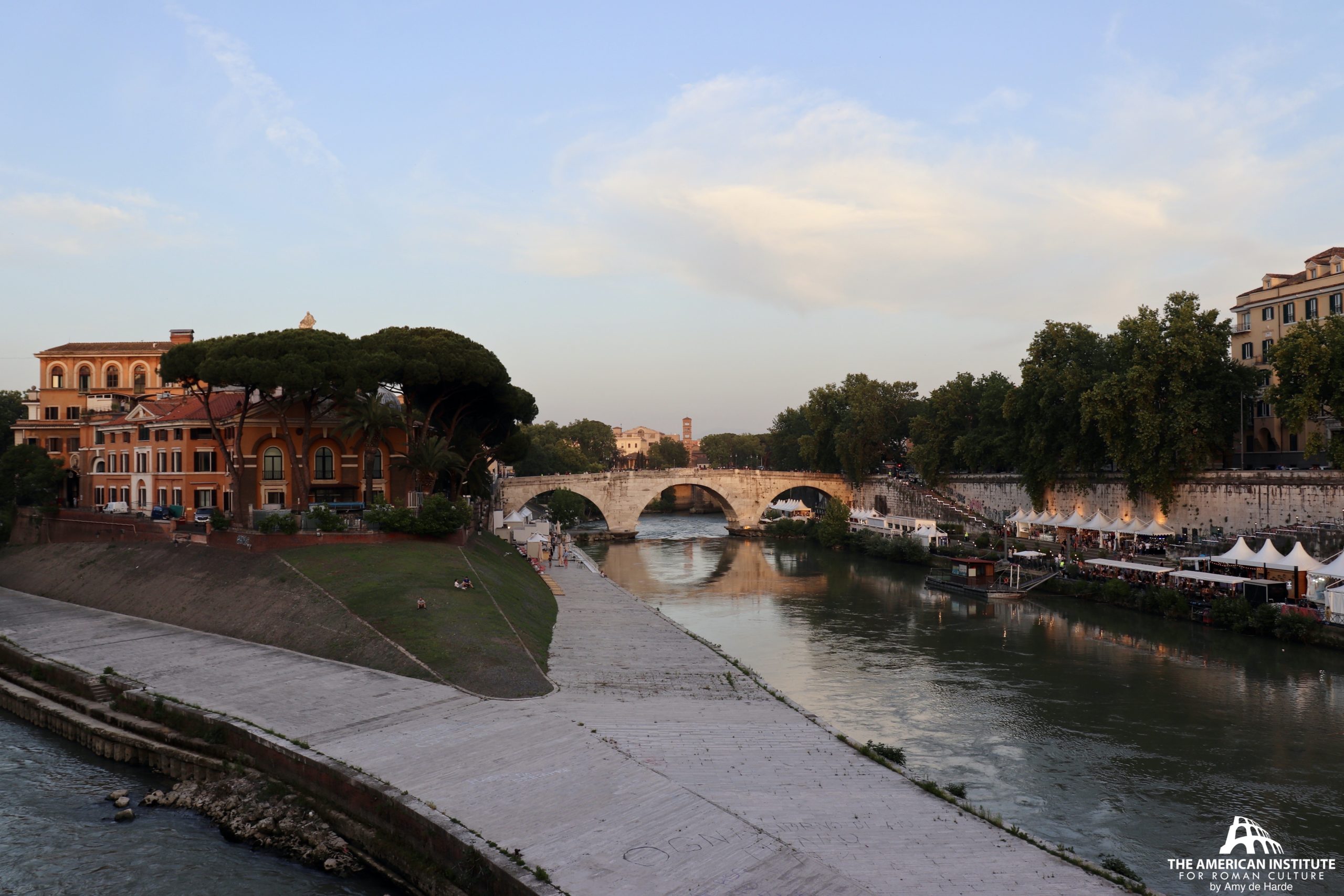

The Pons Cestius connects Tiber Island to the west bank of the Tiber River. It was originally built in the 1st century BCE, sometime after the nearby Pons Fabricius. The identity of the bridge’s builder is uncertain. As with many Roman bridges, it was likely named after the person who sponsored its construction, probably a member of the gens Cestia. Two possible candidates are Gaius Cestius (who served as praetor in 44 BCE and was buried in the famous Pyramid of Cestius) or his brother, Lucius Cestius.
At some point in the 2nd century CE, the bridge may have been restored during the reign of Antoninus Pius. A Fasti inscription from Ostia records that the emperor rebuilt a bridge in Rome. Scholars debate whether this refers to the Pons Cestius or to the Pons Agrippae. If Antoninus Pius did not restore it, the original bridge may have survived for nearly four centuries without major reconstruction – unless repairs went unrecorded.
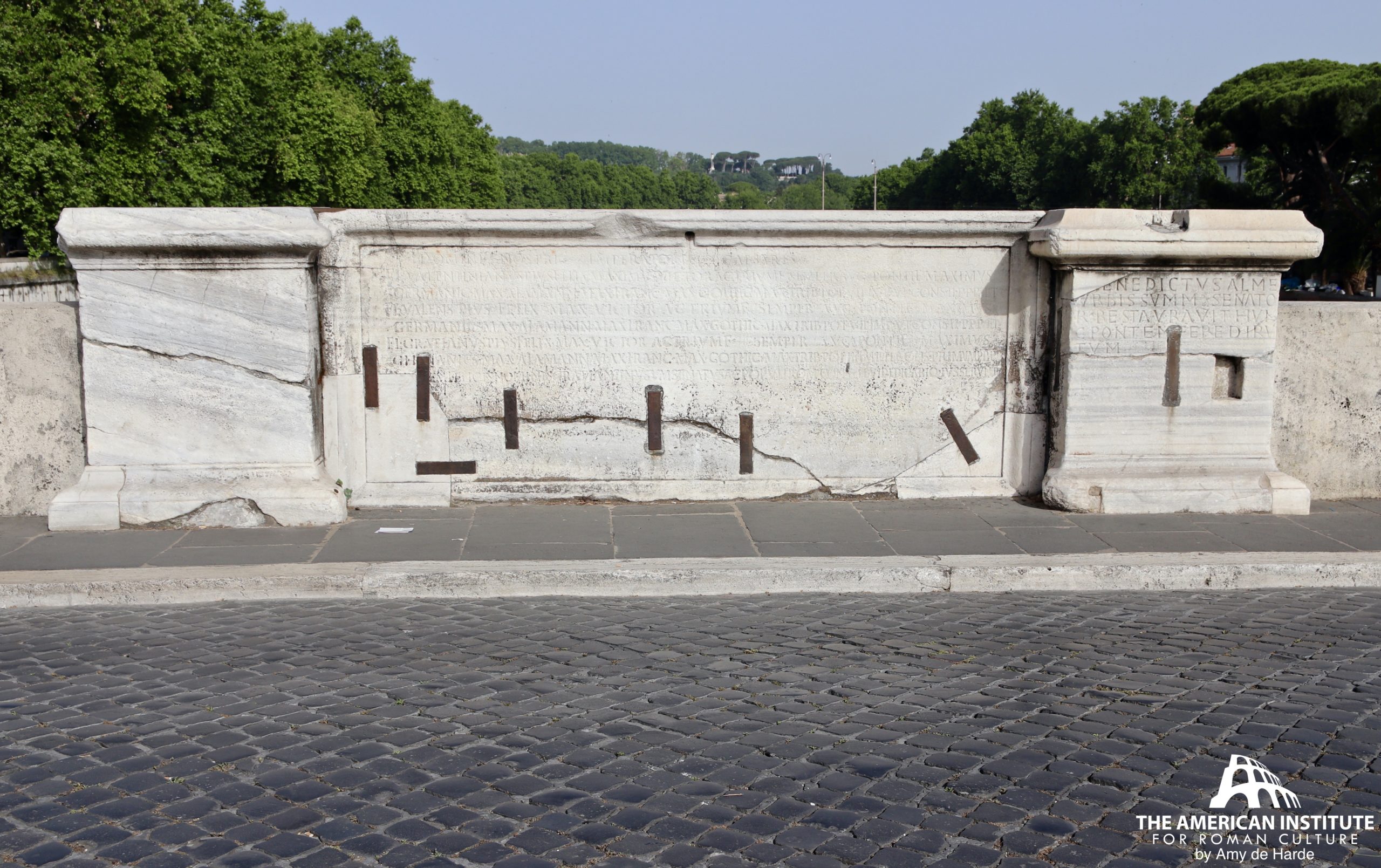
The bridge was completely rebuilt in the 4th century CE and rededicated as the Pons Gratiani. An inscription records that the emperors Valentinian I, Valens, and Gratian ordered the reconstruction in 370 CE. Today, only the central arch preserves part of the ancient structure.
The dedication inscription reads:
GR[ATI]AN[I TRI]VMFALIS P[RIN]CIPIS [PO]NTEM AE[T]E[RNITATI AVGVSTI NOMINIS CONSECRATVM IN VSVM SENATVS POPVLIQVE ROMAN]I DDD NNN VAL[EN]TINIANVS V[ALEN]S ET GRA[TIA]N[V]S [VICTO]RES MAXIMI AC PERENNES AVGVSTI INCOHA]RI PERFICI DEDICA[RIQVE IVSSERVNT].
It can be translated as:
“Our lords Valentinian, Valens, and Gratian – greatest conquerors and eternal Augusti – ordered the bridge, dedicated to the eternal name of Gratian, triumphant emperor, to be begun, completed, and dedicated for the use of the Senate and People of Rome.”
(Translation by Tyler Landsford, The Latin Inscriptions of Rome: A Walking Guide, pp.456–457.)
According to Samuel Ball Platner and Thomas Ashby, the ancient bridge measured about 48 meters long and 8.2 meters wide. Its central arch spanned 23.65 meters, while two smaller side arches each measured about 5.8 meters.
In the late 19th century, construction of the Tiber’s flood walls required the bridge to be demolished and rebuilt. The ancient structure, designed with one large central arch and two small side arches, was not long enough to span the widened riverbanks. The modern bridge was therefore rebuilt with three large arches, although the central arch reused some ancient material. These works also damaged the surviving inscription.
Today the bridge is also known as the Ponte San Bartolomeo, named after the nearby Basilica di San Bartolomeo all’Isola on Tiber Island.
Bibliography:
- Claridge, Amanda. Rome: An Oxford Archaeological Guide. Oxford: Oxford University Press, 2010.
- Coarelli, Filippo. Rome and Environs: An Archaeological Guide. Berkeley: University of California Press, 2014.
- Landsford, Tyler. The Latin Inscriptions of Rome: A Walking Guide. Baltimore: Johns Hopkins University Press, 2009.
- Platner, Samuel. “Pons Cestius.” In A Topographical Dictionary of Ancient Rome (pp.399‑400). London: Oxford University Press, 1929. Retrieved from: https://penelope.uchicago.edu/Thayer/E/Gazetteer/Places/Europe/Italy/Lazio/Roma/Rome/_Texts/PLATOP*/Pons_Cestius.html
- Taylor, Rabun. “Tiber River Bridges and the Development of the Ancient City of Rome.” The Waters of Rome. 2002. https://waters.iath.virginia.edu/taylor_bridges.html

PONS CESTIUS, the modern Ponte S. Bartolomeo, the first stone bridge from the island to the right bank of the river. It is mentioned only in Not. app. and Pol. Silv. (545), but probably was built soon after the pons Fabricius. Several Cestii of some prominence are known in this period, and the bridge was probably constructed by one of them, while curator viarum, between 62 and 27 B.C.
In the fourth century the pons Cestius was replaced by what was practically a new structure, which the Emperors Valentinian I, Valens and Gratian finished in 369 (Sym. Pan. in Grat. p. 332) and dedicated in 370 as the pons Gratiani. There were two inscriptions recording this event, each in duplicate, the first cut on marble slabs placed on the parapet on each side of the bridge, the second beneath the parapet (CILvi. 1175, 1176). One of the former is still in situ. The pons Gratiani was 48 metres long and 8.20 wide, with one central arch, 23.65 metres in span, and a small arch on each side, 5.80 metres wide. The material was tufa and peperino with facing of travertine, and the pedestals of the parapet probably supported statues of the emperors as those of the pons Fabricius did hermae. The construction was rough and characteristic of the decadence, and very little of the earlier pons Cestius could have survived in the later structure, although the general appearance and form of the two bridges were doubtless about the same.
The pons Gratiani was restored at various times between the twelfth century and 1834, but in 1888-1892 the building of the new embankment and the widening of the channel made it necessary to take down the old bridge and erect a new one, 80.40 metres long, with three arches. The central arch of the new structure reproduces the original exactly, although only about one-third of the old material could be used again (Jord. i. I. 418-420; Mitt. 1889, 282-285; Besnier 106-119, and literature there cited).
This content is brought to you by The American Institute for Roman Culture, a 501(C)3 US Non-Profit Organization.
Please support our mission to aid learning and understanding of ancient Rome through free-to-access content by donating today.
Join our free newsletter to receive more ancient Rome content, lecture and Masterclass invites, travel course news and more:
Cite this page as: Ancient Rome Live, The American Institute for Roman Culture, “Pons Cestius (Pons Gratiani)“. Last modified
May 25, 2026. https://ancientromelive.org/pons-cestius-pons-gratiani/
Created by The American Institute of Roman Culture, published on
November 16, 2019 under the following license: Creative Commons: Attribution-NonCommercial-ShareAlike. This license lets others remix, tweak, and build upon this content non-commercially, as long as they credit the author and license their new creations under the identical terms. Please note that content linked from this page may have different licensing terms.