


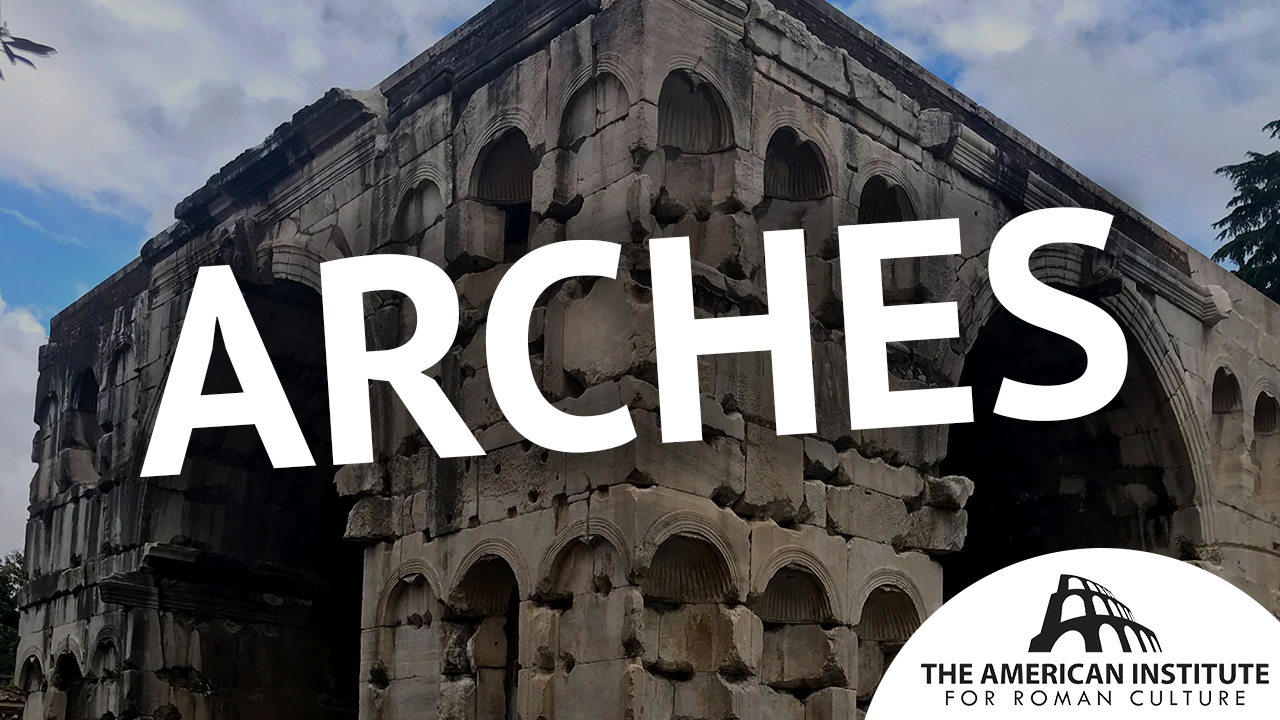
The Arch of Constantine is a monumental triumphal arch built in Rome between 312 and 315 CE. Emperor Constantine dedicated it to his victory over his rival and co-emperor Maxentius following the Battle of the Milvian Bridge in 312 CE, which was fought just outside the city. The arch stands in the valley of the Colosseum, along the traditional route used for Roman triumphal processions. Unlike most Roman triumphal monuments, which celebrated victories over foreign enemies, the Arch of Constantine is distinctive because it commemorates a victory in a Roman civil war.
At 21 meters high, 25 meters wide, and 7 meters deep, the Arch of Constantine is the largest surviving Roman triumphal arch. An inscription on the monument explains its purpose.
To the Emperor Caesar Flavius Constantine, the greatest, pious, and blessed Augustus: inspired by divinity, in the greatness of his mind, he used his army to save the state by the just force of arms from a tyrant on the one hand and every kind of factionalism on the other; therefore the Senate and the People of Rome have dedicated this exceptional arch to his triumphs.
By presenting Maxentius as a tyrant, the inscription justifies Constantine’s civil war victory as an act of liberation rather than rebellion.
The arch was carefully designed to legitimize Constantine’s rule through political and religious symbolism. One of the most important strategies was the extensive use of spolia, the reuse of sculptural elements taken from earlier imperial monuments. By incorporating reliefs originally created for respected emperors such as Trajan, Hadrian, and Marcus Aurelius, Constantine visually aligned himself with Rome’s most admired rulers and emphasized continuity with the imperial past.
Reliefs taken from a Trajanic monument celebrating the Dacian Wars show scenes of battle and victory, highlighting Constantine’s military strength and suggesting divine favor. Other panels came from a now-lost triumphal arch of Marcus Aurelius, known only through ancient texts. These reliefs depict imperial duties such as addressing troops and distributing gifts, presenting Constantine as a just, generous, and responsible ruler. Some scholars also suggest that the friezes traditionally called “Constantinian” may have originated in an earlier monument from the reign of Diocletian and were later adapted for the arch.
The Hadrianic roundels, or circular medallions, were also altered to promote Constantine and his co-ruler Licinius. In these reliefs, the faces of earlier emperors were re-carved to resemble the new rulers, reinforcing their authority and shared leadership. Several figures wear a radiate crown, an attribute associated with Sol, the Roman sun god. This symbol had been used by earlier emperors, including Augustus and Nero, to express divine favor and imperial legitimacy.
The location of the Arch of Constantine further strengthened its symbolism. It was deliberately placed near the Colosseum and the colossal statue of Sol (originally the Colossus of Nero). From certain viewpoints, the arch was positioned to visually frame the massive statue, which stood approximately 30 meters (100 feet) tall. This careful alignment reinforced Constantine’s association with Sol Invictus and connected his rule to divine protection and cosmic authority.
Bibliography:
- Grout, James. “Arch of Constantine.” University of Chicago. https://penelope.uchicago.edu/encyclopaedia_romana/romanurbs/archconstantine.html
- Hendrix, David. (2016). “Arch of Constantine.” The Byzantine Legacy. https://www.thebyzantinelegacy.com/constantine-arch
- Marlowe, E. (2006). “Framing the Sun: The Arch of Constantine and the Roman Cityscape.” The Art Bulletin, 88(2), 223–242. https://doi.org/10.1080/00043079.2006.10786288
- Platner, Samuel. (1929). “Arcus Constantini.” In A Topographical Dictionary of Ancient Rome (p.36-38). Retrieved from: https://penelope.uchicago.edu/Thayer/E/Gazetteer/Places/Europe/Italy/Lazio/Roma/Rome/_Texts/PLATOP*/Arcus_Constantini.html
- Rose, C.B. (2021). “Reconsidering the frieze on the Arch of Constantine.” Journal of Roman Archaeology 34(1), 175-210. https://doi.org/10.1017/s1047759421000015
Arcus Constantini: erected by the senate in honour of Constantine to commemorate his victory over Maxentius in 312 A.D., as the inscription in the attic records.
Read more:
Sed laoreet mauris augue, feugiat varius urna tempor non. Fusce ut augue porttitor, interdum nisl non, imperdiet sapien. Class aptent taciti sociosqu ad litora torquent per conubia nostra, per inceptos himenaeos. Vivamus nec sapien tortor. Quisque turpis tellus, maximus sed leo sit amet, placerat gravida dui. Maecenas interdum quam at lectus auctor, ac sagittis mi consectetur. Mauris auctor nisi in tristique volutpat. Pellentesque a lacus elit.
\
Fusce sit amet vehicula justo. Suspendisse potenti. Cras efficitur et purus rutrum dapibus. Donec non mauris in justo tempor luctus. Class aptent taciti sociosqu ad litora torquent per conubia nostra, per inceptos himenaeos. Vestibulum id maximus lectus, quis posuere sapien. Suspendisse scelerisque rhoncus quam, nec mattis urna porta id. Aliquam eget nisi sit amet diam sodales sollicitudin. Duis mollis ac mi quis commodo. Integer vestibulum dui et nisi pulvinar finibus. Maecenas quis luctus tortor, vitae accumsan libero. In dapibus vitae purus ut dignissim. Mauris eu nulla mattis, commodo nisi quis, consequat tortor.
\
Duis blandit nisl id leo laoreet, nec porta augue ornare. Morbi vitae enim ac ante auctor bibendum. Donec sit amet accumsan sapien. Vestibulum eget blandit orci. Vestibulum id luctus dui, ut commodo velit. Nulla eu diam nec justo placerat gravida non volutpat mi. Phasellus posuere sapien et tristique consectetur. Aliquam quis pulvinar metus. Praesent vel nisi dolor. Phasellus porttitor ut orci ut gravida.
\
Vestibulum odio est, eleifend in consequat condimentum, aliquet eget tellus. Sed quis posuere dui. Integer iaculis ipsum purus, nec posuere nisl facilisis ut. Mauris bibendum orci vitae leo rhoncus, sit amet placerat nulla iaculis. Integer faucibus odio sed dolor sagittis, eget volutpat neque malesuada. Maecenas mauris nunc, iaculis vel fringilla eget, posuere quis libero. Fusce aliquam scelerisque diam nec vestibulum. Vivamus fermentum rutrum nibh, at convallis turpis consequat eu.
\
Aliquam eu augue at mi gravida sollicitudin sed at mauris. Donec sed tempor urna. Maecenas purus nunc, sollicitudin ac lorem eu, maximus auctor quam. Cras eu ipsum id lacus vulputate fermentum. Quisque dictum est id dui cursus commodo. Ut eget pharetra nulla. Aliquam ultricies interdum magna in suscipit. Etiam non quam lorem. Cras eget mauris sed nisl accumsan gravida id faucibus tellus. Vivamus sed tempor purus. Duis nisl odio, placerat non tempus in, porttitor vel orci. Morbi nec neque eu augue pellentesque mattis. Proin tempus in turpis in maximus. Pellentesque habitant morbi tristique senectus et netus et malesuada fames ac turpis egestas. Sed semper sagittis maximus. Sed fringilla velit at purus fringilla finibus.
\
Mauris dignissim ullamcorper iaculis. Pellentesque sit amet dictum libero. Nullam non augue purus. Donec quis lobortis massa. Donec pulvinar pharetra quam at fringilla. Phasellus non luctus libero. Proin quis diam vel nunc aliquet posuere. Integer ante mi, viverra at congue vel.
This content is brought to you by The American Institute for Roman Culture, a 501(C)3 US Non-Profit Organization.
Please support our mission to aid learning and understanding of ancient Rome through free-to-access content by donating today.
Join our free newsletter to receive more ancient Rome content, lecture and Masterclass invites, travel course news and more:
Cite this page as: Ancient Rome Live, The American Institute for Roman Culture, “Arcus Constantini (Arch of Constantine)“. Last modified
June 20, 2026. https://ancientromelive.org/arcus-constantini-arch-of-constantine/
Created by The American Institute of Roman Culture, published on
March 19, 2021 under the following license: Creative Commons: Attribution-NonCommercial-ShareAlike. This license lets others remix, tweak, and build upon this content non-commercially, as long as they credit the author and license their new creations under the identical terms. Please note that content linked from this page may have different licensing terms.